PR Pitch Timing: Why Yours Keeps Getting Deleted

TLDR:
- Our PR pitch isn't badly written. It arrived after the story was already assigned to someone else.
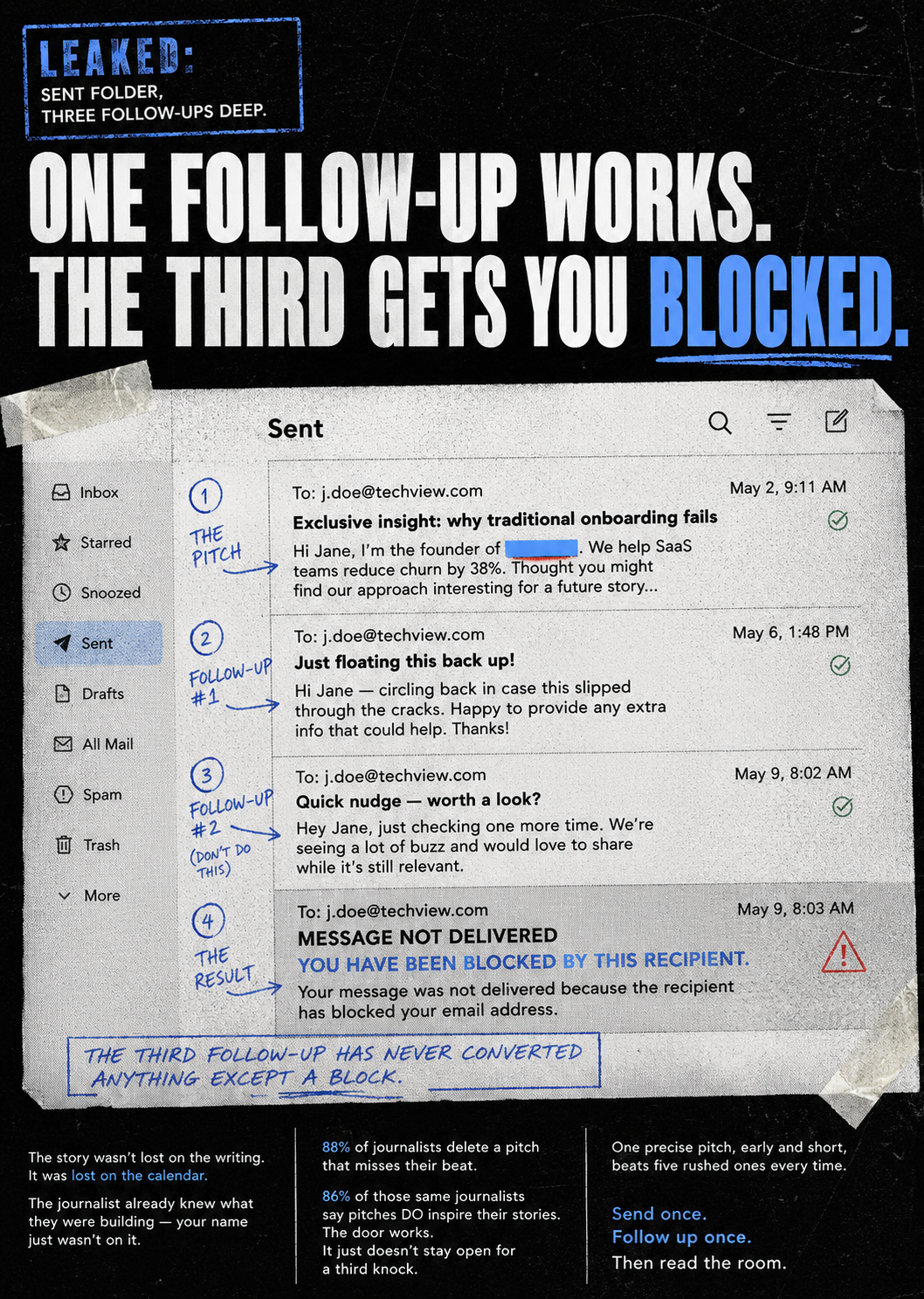
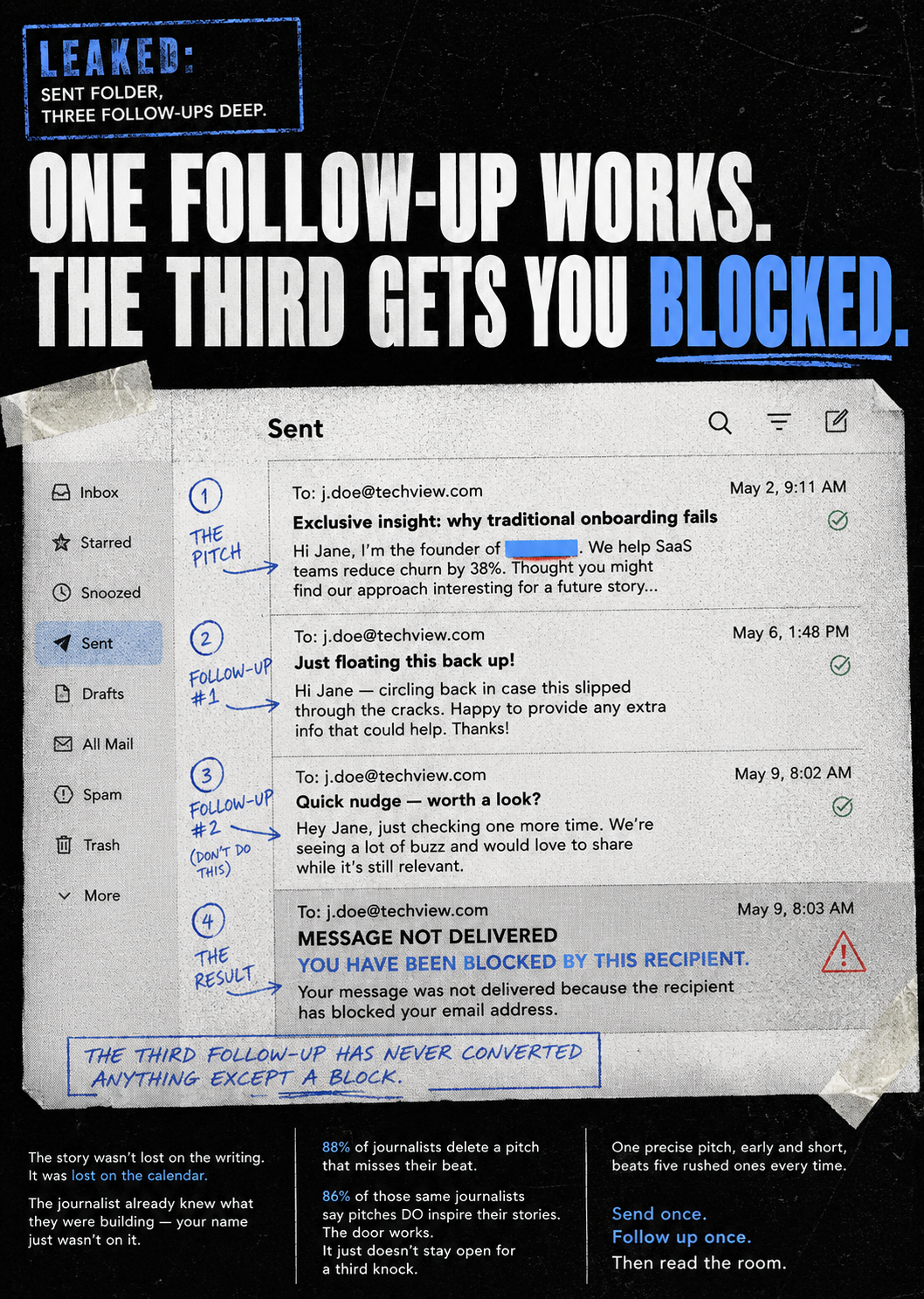
- 88% of journalists delete a pitch that misses their beat. Sending more isn't a plan, it's a nervous habit.
- Reporters work in the planned tense. You're pitching what happened. They're building what runs next.
- Press coverage goes to contribution, not conversion. Bring material, not ask.
- One precise pitch beats five rushed ones. That's not encouragement, that's how the filter works.
Here's the thing nobody says in the kickoff call: the journalist you're pitching already knows what they're writing. Not vaguely. Specifically. There's a plan, an editor signed off on it, and your name appears on it exactly zero times.
And you're sending a product announcement.
Let me translate the silence for you. It isn't rejection. It's a scheduling conflict you didn't know you were in.
Most teams respond to this by going the wrong direction entirely. More sends. Bigger lists. A third follow-up. Every PR pitch aimed at people who weren't taking submissions for that thing in the first place.
Why Your PR Pitch Gets Deleted in Four Seconds
Everyone wants this to be an effort problem, because effort is fixable by working harder and nobody has to admit anything.
It isn't an effort problem.
Muck Rack's State of Journalism 2026 report puts the number where it hurts: 88% of journalists delete pitches that miss their beat. Not skim. Not archive. Delete, somewhere between two sips of coffee.
Then the twist that should reframe your whole quarter: 86% of those same journalists say pitches do inspire at least some of their stories. The mechanism works. It works constantly. It just doesn't work for a PR pitch landing at the wrong point in the cycle.
What they meant to say was: we're not ignoring you, we're already busy with the thing you should have pitched into.
The volume makes it worse. Cision's State of the Media research, surveying more than 3,000 journalists, found over half receive 50-plus pitches a week. You're not competing with other brands. You're competing with fatigue. The full data breakdown on why most pitches don't land is worth reading before your next send.
The Editorial Calendar Your PR Pitch Keeps Missing
Reporters and editors don't work in the present tense. They work in the planned tense.
Outlets run on an editorial calendar, the schedule that decides what publishes and when. Themes, features, special issues, trend packages. It exists because newsrooms can't improvise a publication, and it's usually locked well before anything appears.
Here's the part that should annoy you: a lot of it is public. Outlets publish editorial calendars in their media kits, filed under advertising, because they want advertisers to know what's coming. Nobody stops PR people from reading it. Almost nobody does.
The rest you can reconstruct for free. Look at what a reporter has covered recently and the pattern appears fast. Read their posts, where they frequently announce what they're working on and ask for sources outright. That's not a secret. It's a request, and most brands scroll straight past it.
So the useful question stops being "what do we want to announce" and becomes "what are they already building, and do I have a piece of it." Those produce very different emails.
The Two Ways Brands Blow Their Press Coverage
There are two failure modes, and brands pick one and commit to it with alarming loyalty.
Going quiet. The assumption that the window closed, so why bother. Meanwhile a reporter is actively assembling something and taking sources, and your competitor, who is not smarter than you, simply emailed.
Panic-pitching. The opposite reflex. A blast of last-minute promotional media outreach with a subject line containing the word exclusive, which it is not.
Neither works, because neither is useful. Urgency is a you-problem. Journalists have never once cared about your internal deadline, and I say that with love and some experience.
For the full catalogue of self-inflicted damage, these are the pitch mistakes that end careers. Some are funny. Most are things you've done.
PR Pitch Angles That Actually Earn Press Coverage
The angles that convert share one trait. They hand the journalist material instead of asking for a favor.
- A lesson from something that went wrong. Specific, unflattering, true. Nobody has ever been quoted for saying the launch went smoothly.
- A shift you can see from where you sit. You have visibility into your category that a reporter covering forty companies doesn't. That's a source relationship, not marketing.
- Original data. Even small numbers from your own operation beat the recycled third-party stat that eleven other pitches also used this week.
- Commentary they can build on. A position sharp enough to quote and short enough to use.
Contribution, not conversion. Any PR pitch that's secretly a sales email reads as a sales email, and the read takes about four seconds.
Worth knowing where this compounds: Muck Rack's analysis of more than a million cited links found earned media accounts for the overwhelming majority of AI citations, not brand-owned pages. So press coverage earned by being useful keeps working inside AI-generated answers long after the article stops getting clicks. Your homepage doesn't do this. It has never done this.
Why One Good PR Pitch Beats Five Rushed Ones
This sounds like something you say to feel better about sending fewer emails. It isn't.
Muck Rack's data on format is blunt: journalists prefer short, one-to-one emails, sent early in the day, with a single timely follow-up. Not a sequence. Not a nurture flow. One.
Five rushed pitches to a loosely relevant list produces five deletions and a small amount of permanent reputational damage, because reporters remember names attached to noise. One precise PR pitch to someone actively building the thing you have produces a conversation.
There's a trust dimension too. The Edelman Trust Barometer, based on roughly 34,000 respondents across 28 countries, found seven in ten people are unwilling or hesitant to trust someone whose values, background, or information sources differ from their own. Cold outreach is structurally a stranger asking for something. Volume makes you a more frequent stranger, not a more familiar one.
How to Time a PR Pitch So It Actually Lands
None of this needs a bigger team. It needs reading before writing.
- Pull the outlet's media kit and check the advertising page for a published editorial calendar
- Reconstruct the rest from coverage patterns and the reporter's own posts, which are free and often explicit about what they need
- Work backward from publication, not forward from your announcement. Features get assigned far earlier than most brands assume
- Lead with material, not the task. Data, a position, a source, a specific observation
- Send one, early, short. Follow up once. Then stop, because the third follow-up has never converted anything except a block
- Track which angle worked, not how many you sent
A better PR pitch isn't louder. It's earlier, shorter, and aimed at something that already exists. Here's the longer version on pitching journalists properly if you want the mechanics.
Most brands don't need a bigger media list. They need to stop emailing the one they've got. Don't Be A Little Pitch fixes the aim before the volume.
FAQ
What makes a good PR pitch?
Relevance to what that specific journalist covers, a clear angle their readers would care about, and material they can build on such as original data or a credible source. Short beats thorough. Most pitches fail on the angle, not the writing.
Why do journalists ignore PR pitches?
Because the pitch doesn't match their beat or the story they're currently building. Muck Rack's research shows 88% of journalists delete off-beat pitches immediately, and over half receive more than 50 a week, so anything not obviously relevant gets cleared fast.
How far in advance should you pitch a journalist?
Earlier than most brands assume. Features and forward-looking coverage get assigned well before publication, so a pitch arriving alongside the news is arriving after the story was already given to someone else. Daily news is the exception and moves the same-day.
How do I find a publication's editorial calendar?
Start with the outlet's media kit, usually linked from its advertising or partnership page, since editorial calendars are published there for advertisers. If none exists, reconstruct the pattern from past coverage and from what reporters say publicly about what they're working on.
How many pitches should I send?
Fewer than you're sending now. Journalists surveyed by Muck Rack prefer short, one-to-one emails. A precise pitch to a handful of genuinely relevant reporters consistently outperforms a broad send to a purchased list, and it doesn't damage your name.
Should I follow up if a journalist doesn't reply?
Once, briefly, then leave it. Journalists accept a single timely follow-up. Repeated chasing costs you more than the original silence did, and reporters do remember which names generate noise.
Does a PR pitch still matter if AI is answering search queries?
More than before. AI-generated answers draw heavily on earned media rather than brand-owned pages, so third-party coverage now feeds the channel where buyers form opinions. A pitch that lands buys you visibility inside AI results, not just an article.

60-Day Performance Guarantee
PR only works if it builds momentum fast. If we do not secure 2 meaningful earned media features and line up 3 additional opportunities within 60 days, you get a full refund.

Free Authority Score Checker
Check your online reputation and authority score for free and see how you stack up and get custom tips to improve instantly.




.png)