Holiday Sales Aren't a Vibe, They're Infrastructure, and Yours Might Not Survive December

TLDR:
- If your holiday sales are dipping right before the season, that's not a crisis, that's your business telling you something specific
- Most brands respond to a slump with discounts. Smarter brands respond with clarity
- A real Q4 strategy is infrastructure, not a graphic and a promo code
- A sales surge isn't a discount, it's a moment people can't scroll past
- If your plan ends on December 25th, you never actually had a plan
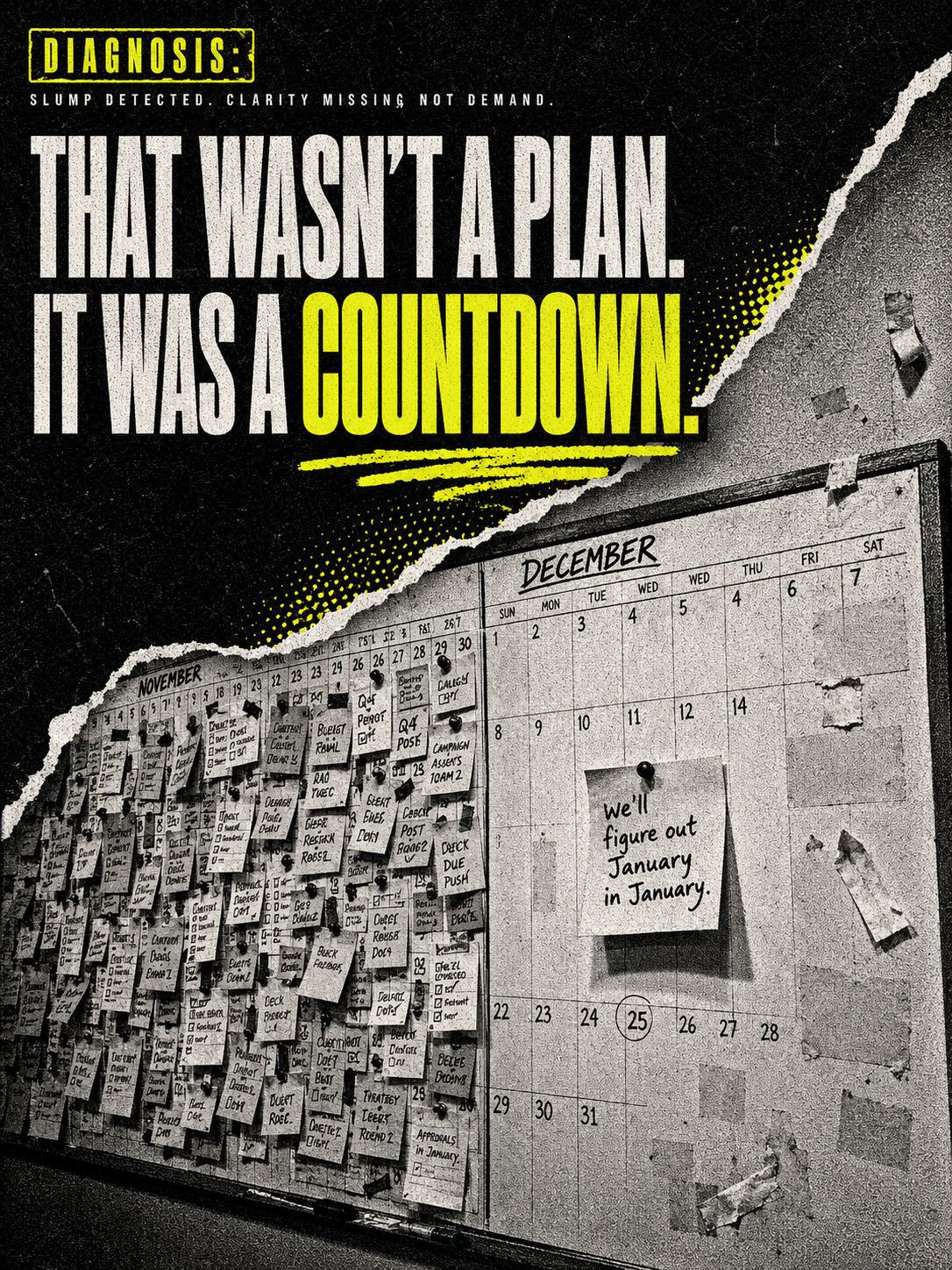
I used to sit in meetings like this. Holiday sales dip a little right before the season kicks in, and instead of asking why, everyone just says "people are busy" and moves on to the next slide. Nobody's busy. They're just not compelled, and there's a difference between those two things that most holiday marketing plans never bother to figure out.
This triggered something in me, honestly, because a slump isn't a death sentence. It's a diagnosis. It's telling you exactly where you got comfortable, repetitive, or quietly boring, and the season is about to make that very, very visible.
Your Holiday Sales Slump Is Not a Personality Flaw, It's a Diagnosis
Every business hits that awkward pre-season dip. Traffic slows. Engagement fades. Your audience goes quiet, and suddenly you're telling yourself a story about everyone being distracted instead of admitting the actual story, which is that nothing you're putting out is compelling anyone to stop scrolling.
Most brands respond by discounting harder. Smart brands respond by getting clearer. 20 percent of small businesses have no way to even measure the impact of their holiday marketing, and 57 percent increase how often they communicate during Q4 without necessarily changing what they're saying, according to small business marketing research from PostcardMania. Who approved the plan where volume replaces clarity, and are they okay?
How to Build a Q4 Strategy That Doesn't Collapse Under Its Own Weight
Season success isn't built on a nice graphic and a fifteen percent code. It's built on infrastructure, messaging that actually lands, operations that don't fall apart under volume, and offers that don't feel like leftovers from last quarter.
Nobody explains this better than Ford Smith, who's watched brands get humbled up close: "One year, a major client underestimated their holiday demand, and we got the call to cover a week's worth of deliveries in a single day. We made it happen, but it was a lesson in how costly a lack of preparation can be. The holidays will test your systems, your partners, and your patience. What we've learned is simple: if you're not building in margin, time, resources, or trust, you're setting yourself up to scramble." That's Ford Smith at A1 Xpress, and translation: if you wait until the season's already here, you're already behind.
The data backs this up beyond one story. Businesses that start planning early, well before the actual seasonal window opens, consistently outperform the ones scrambling in the final weeks, according to holiday retail strategy research from SuccessKnocks, which found the late pre-holiday surge has grown noticeably larger over recent years, meaning the brands without infrastructure get hit twice, once by demand they didn't plan for, and again by competitors who did.
The LIVV Audio Comeback, or How a Real Brand Fixed a Real Slump
When Mark Clayton walked into Don't Be A Little Pitch with LIVV Audio, the brand wasn't failing, it was fading, which in the audio category is somehow worse. There was a great product. A founder story people would genuinely want to hear. A wide open lane. But the energy was gone, the momentum was silent, and the positioning was blurry enough that nobody could explain what LIVV actually stood for in one sentence.
So we did the thing we actually do: cracked the brand open, rebuilt the narrative from scratch, and reframed LIVV as a category story instead of just another headphone story. We revived the founder's voice, injected tension and identity back into the messaging, and repositioned LIVV not as "back," but as "you should've never counted them out" in the first place. The spark came back. The market paid attention. The comeback became the actual headline, not a footnote.
This is what happens when a brand stops playing catch-up and starts playing for real, and it's also proof that a slump is reversible when the fix is structural instead of cosmetic.
How to Actually Create a Sales Surge Instead of Another Discount Code
Every season has a moment where buyers flip from browsing to actually buying. Your job is to be the brand that commands that flip, not the one quietly begging for it in an email subject line.
A real sales surge isn't a discount. It's a drop, a reveal, a collaboration, a statement, something with actual teeth that people can't casually ignore. 63 percent of consumers say they choose smaller brands specifically for unique offerings, and 62 percent say it's about supporting something real, according to holiday marketing research from LocalIQ, which means the surge moment doesn't have to out-discount a big retailer, it has to out-mean one. Safe brands never surge. Bold brands always do.
If your messaging still leans on spin instead of an actual point of view, this piece on why radical honesty beats spin in PR strategy covers exactly why the safe version of your brand voice is the one costing you the surge moment in the first place.
How to Avoid the Post-Holiday Sales Crash Everyone Pretends Won't Happen
The season spike means nothing if the whole thing flatlines the moment the calendar flips. The brands that actually win on holiday sales are the same ones turning one-time buyers into repeat customers, and momentum into an actual foundation for the next quarter instead of a memory.
We really said this with a straight face in a meeting once: "we'll figure out January in January." No. If your plan ends the day the gifts are opened, you never had a plan, you had a countdown. After you've had a real placement or a real surge moment, this breakdown of how to know if your PR efforts are actually working is the exact gut check worth running before the next messaging meeting.
The Bottom Line on Holiday Sales, Since Someone Had to Say It
A slump you ignore stays a slump. Holiday sales aren't something you get through, they're something you leverage, but only if the story, the systems, and the visibility were built before peak demand hit, not scrambled together once it already had.
Don't Be A Little Pitch exists because most brands can build one good moment and have absolutely no plan for what happens the week after. If that sounds a little too familiar, that's usually the actual gap worth closing.
FAQ
Why do holiday sales dip right before the season?
A pre-season dip is usually a sign of audience fatigue with repetitive or unclear messaging, not a lack of buyer interest. It typically signals a clarity or relevance problem rather than a demand problem.
How early should a small business start preparing for holiday sales?
Businesses that begin planning well before the season's peak, rather than in the final weeks, consistently see stronger results, since early preparation allows time to build infrastructure, inventory, and messaging that can handle demand.
What causes a post-holiday sales crash?
A post-holiday crash typically happens when a business has no retention plan beyond the initial sale, meaning there's no follow-up strategy to turn one-time holiday buyers into repeat customers.
How do I create a sales surge instead of just running a discount?
A surge moment relies on a distinct, attention-earning action, like a product drop, collaboration, or bold statement, rather than price cuts alone, since discounts compete on price while a surge moment competes on relevance.
What's the difference between a Q4 strategy and a single holiday sales campaign?
A Q4 strategy is a coordinated system covering messaging, operations, and offers built to handle the full season, while a single campaign is typically a short-term, isolated push that doesn't account for what happens before or after it.

60-Day Performance Guarantee
PR only works if it builds momentum fast. If we do not secure 2 meaningful earned media features and line up 3 additional opportunities within 60 days, you get a full refund.

Free Authority Score Checker
Check your online reputation and authority score for free and see how you stack up and get custom tips to improve instantly.




.png)