AI Tools in PR: Did AI Blow Up the PR Industry or Just Give It a Glow-Up?

TLDR:
- AI tools didn’t replace PR people. They replaced the boring parts of PR people’s jobs.
- Most of the PR industry already uses generative AI, mainly for writing, research, and brainstorming.
- AI handles data, monitoring, and first drafts. Humans still own the storytelling, relationships, and judgment.
- A smart PR strategy follows the 80/20 rule: most of your effort stays human, and AI takes the repetitive grind.
- Journalists can tell when a pitch was written by a robot, so accuracy, personalization, and a human tone still matter most.
The first time someone mentioned AI tools in a meeting I was in, a senior director leaned back and said, “So… are we all getting fired?”
Nobody laughed.
Because honestly? We were all thinking about it.
I used to sit in meetings like this constantly. Someone would say “AI” and half the room would panic while the other half nodded like they understood it. (They did not understand it.)
So let’s settle this. Did AI destroy the PR industry, or did it just give it a really good haircut?
Is AI Bad for PR? Why AI Tools Get Such a Bad Rap
AI has a reputation problem. People see it as fake, lazy, or careless, like a robot pretending to have feelings in a LinkedIn post. And fine, that’s fair-ish. AI doesn’t have emotional depth. It doesn’t have the human spark that makes a story land.
But that was never really the point. The question was always how we use it.
Here’s the thing that took me way too long to understand. AI copies how humans think, but it can only work with what we feed it: human-made data, inside a human-built framework. So it’s a two-way relationship. We shape what it learns, and it supports what we do.
AI isn’t the boss here. It’s more like the world’s fastest intern who never needs coffee.
How AI Works in Public Relations: The Painter and the Paintbrush
Let me be honest about something.
When I first watched AI pull together research in seconds that would’ve taken me hours, I spiraled a little. Because what was I even doing all that time? Staring at a blank doc? Rewriting the same opening line nine times? Feeling the full emotional weight of a press release about a software update?
This triggered something in me. What do I actually bring to the table?
And then it clicked.
AI is everywhere. So are we. In public relations, we’re the painters and AI is the paintbrush. We bring the creativity, the feelings, the perspective, the “wait, what if we tried this?” AI gives us better tools to sharpen and amplify what’s already in our heads.
No more blank pages. No more three-hour stare-downs with a cursor. AI helps turn rough ideas into stories people actually care about, faster and sharper than we could manage alone.
Will AI Replace PR Professionals? (Let’s Talk About It)
Every time AI comes up in PR, someone asks the same thing: is it here to steal my job?
And look, the resistance makes sense. Why change anything when you’ve been running solid campaigns, writing nonstop, and getting results?
But AI can’t do the parts of this job that actually matter most. It can’t copy your creativity, your empathy, or your strategic brain. It can’t read a client’s mood on a call, or figure out what they need but haven’t said yet.
What it can do is take the grunt work: repetitive tasks, data crunching, and insights that help you make smarter calls. That frees PR people to focus on the work that matters, like building relationships, telling better stories, and putting out fires before they spread.
And most of the industry has already figured this out. According to PRSA’s coverage of Muck Rack’s State of AI in PR report, 76% of PR professionals use generative AI in their work, and only 7% say they don’t use it and don’t plan to start.
So no. AI probably isn’t taking your job. But someone who knows how to use it well might.
The 80/20 Rule for Using AI Tools in PR
This is the part that saved my sanity.
The 80/20 rule for AI in PR goes like this: 80% of your effort stays human. That means storytelling, building connections, and coming up with fresh ideas. The other 20%, the repetitive, soul-draining stuff, is where AI tools do the heavy lifting.
Think media monitoring, data analysis, first drafts, and organizing research. AI handles that, so you can spend your energy on the work that actually needs your expertise, creativity, and emotional intelligence.
I used to watch people spend entire afternoons formatting coverage reports by hand.
We really said this was a good use of time with a straight face.
And one important rule: keep a human in charge of anything that goes out the door. Muck Rack’s State of AI in PR findings show 82% of PR pros say generative AI improves the quality of their work, and 90% would feel more comfortable with AI agents if a human had to approve their actions. Translation: use the robot, but don’t let the robot hit send.
How AI Improves PR Strategy With Data
PR used to be mostly strategy and gut instinct. Someone would say “I just feel like this will resonate,” and everyone would nod.
Who approved that, and are they okay?
AI changed that. Your PR strategy now gets to be strategy plus real data, and AI doesn’t just collect it. It helps make sense of it.
- Sentiment analysis shows how people feel about your brand as conversations happen.
- Audience segmentation helps tailor your message to exactly the right people.
- Predictive trend analysis helps you spot what’s coming before everyone else jumps on it.
So “I just feel like” becomes “here’s what the data says.” Creativity meets science, and suddenly your campaigns have actual receipts. If you want the bigger picture, here’s how to build a PR strategy that actually gets you coverage.
How AI Changed the PR Industry: The Glow-Up
Far from destroying PR, AI made it smarter, faster, and honestly more fun. Here’s what that glow-up looks like:
- Better insights. You know your audience better than they know themselves. (Slightly creepy. Very useful.)
- Stronger campaigns. Your strategy actually hits instead of vaguely gesturing at a target.
- More time to be creative. All those hours AI saves? They go into stories that actually move people.
Basically, the PR industry is doing better because of AI, as long as we hold on to the human part that makes this work irreplaceable.
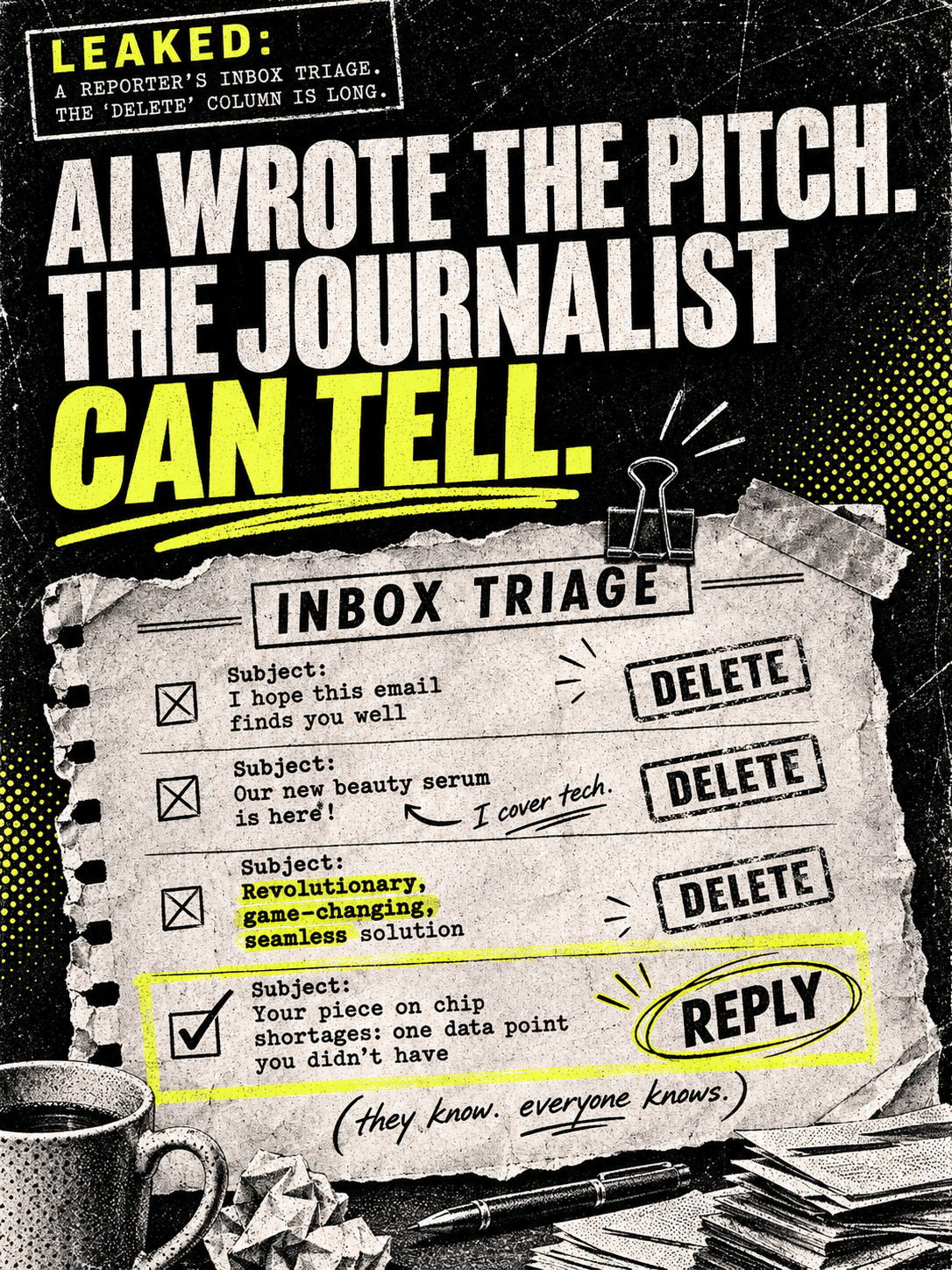
Because journalists can absolutely tell when you didn’t. Cision’s research, reported by PR Daily, warns PR pros to be careful with AI in anything sent to journalists, because accuracy, personalization, and a human tone are critical. It also says to focus on what AI can’t replace: exclusive access, nuanced insight, and authentic storytelling.
That robotic pitch with “I hope this email finds you well” and three bolded buzzwords? They know. Everyone knows.
The AI Tools for PR We Actually Use
Mass emailing journalists used to be the PR version of screaming into the void. Using AI the right way is more like leaning over and whispering exactly what they want to hear.
AI can analyze a journalist’s past coverage, interests, and social activity, so your pitches get targeted. It’s basically a crystal ball that says, “Don’t bother Jane with this. She covers tech, not beauty.” (Jane thanks you. Jane was tired.) If your pitches still aren’t landing, here’s why your media relations stopped working.
At Don’t Be A Little Pitch, we take brands and crank the volume up to 11, turning their stories into headlines that actually hit. We move fast, we stay sharp, and we’ve got a few trusty sidekicks helping us do it:
- Google NotebookLM is the brain. It stores, organizes, and makes sense of our ideas, research, and insights. It’s where the thinking happens, and it keeps us sharp when we’re juggling complicated projects or brainstorming new strategies.
- Monday.com is the spine. It keeps everything upright and moving. Tasks flow, deadlines get hit, and every project stays on track.
- Missive is the hands. It’s where the action happens. We collaborate, send messages, and get things done together without dropping the ball.
Together, they keep our whole operation running at full speed, while the humans handle the parts that actually need a human.
What AI in PR Means for Your Brand
Here’s what I figured out after all those panicked meetings.
AI didn’t blow up PR. It blew up the busywork. The blank pages, the spreadsheets nobody needed, the hours spent on tasks that never needed a human brain in the first place.
What’s left is the good stuff: stories, relationships, strategy, and judgment. The parts that were always the point.
We’re not just talking about AI. We use it every day to shape where PR goes next, one pitch at a time. And as AI changes how people find brands, earning trusted coverage matters even more. It’s part of why thought leadership is the real reason you’re getting press coverage or not.
So if you’re curious how AI and real storytelling can work together for your brand, we’re always down to talk about it.
Don’t Be A Little Pitch pairs smart tools with very human storytelling, so your brand sounds like you and not like a chatbot. Curious what that looks like for you? Let’s chat.
FAQ
How is AI used in PR?
PR professionals use AI for tasks like brainstorming, drafting content, research, media monitoring, sentiment analysis, audience segmentation, and finding relevant journalists. AI speeds up repetitive work, while people handle strategy, storytelling, and relationships.
Will AI replace PR professionals?
AI is unlikely to replace PR professionals because it can’t build relationships, read client needs, show empathy, or make strategic judgment calls. It’s more likely to change how PR work gets done, with professionals who use AI well gaining an advantage.
What are the best AI tools for PR?
The right tools depend on your needs. Common categories include generative AI writing assistants, research and note-taking tools like Google NotebookLM, media monitoring and journalist database platforms, social listening tools, and project management platforms like Monday.com.
Can AI write press releases and pitches?
AI can help draft press releases and pitches, but they should always be reviewed and edited by a person. Journalists value accuracy, personalization, and a human tone, so AI-generated content that sounds generic is less likely to get coverage.
Should PR agencies disclose their use of AI to clients?
Many brands prefer transparency about how agencies use AI. Being clear about which tasks use AI and how human review works helps build trust and sets clear expectations.
What are the risks of using AI in public relations?
The main risks include factual errors, generic or impersonal messaging, privacy concerns, and over-reliance on automation. A clear AI policy and human review of anything sent to clients or journalists help reduce these risks.

60-Day Performance Guarantee
PR only works if it builds momentum fast. If we do not secure 2 meaningful earned media features and line up 3 additional opportunities within 60 days, you get a full refund.

Free Authority Score Checker
Check your online reputation and authority score for free and see how you stack up and get custom tips to improve instantly.