Crisis Management for Bad Press: How to Remove Negative Articles from Google

TLDR:
- Modern crisis management is mostly a Google problem: whatever shows up when people search your name is your reputation.
- Negative press ranks well because it matches your name perfectly and people can’t resist clicking bad news.
- Google rarely deletes articles on request. Real removal usually starts with the publisher, and Google’s tools only update results once the page changes.
- When removal isn’t possible, reputation management means outranking the damage with credible, positive content.
- The best defense is a written crisis management plan, regular monitoring of your search results, and a steady stream of strong content.
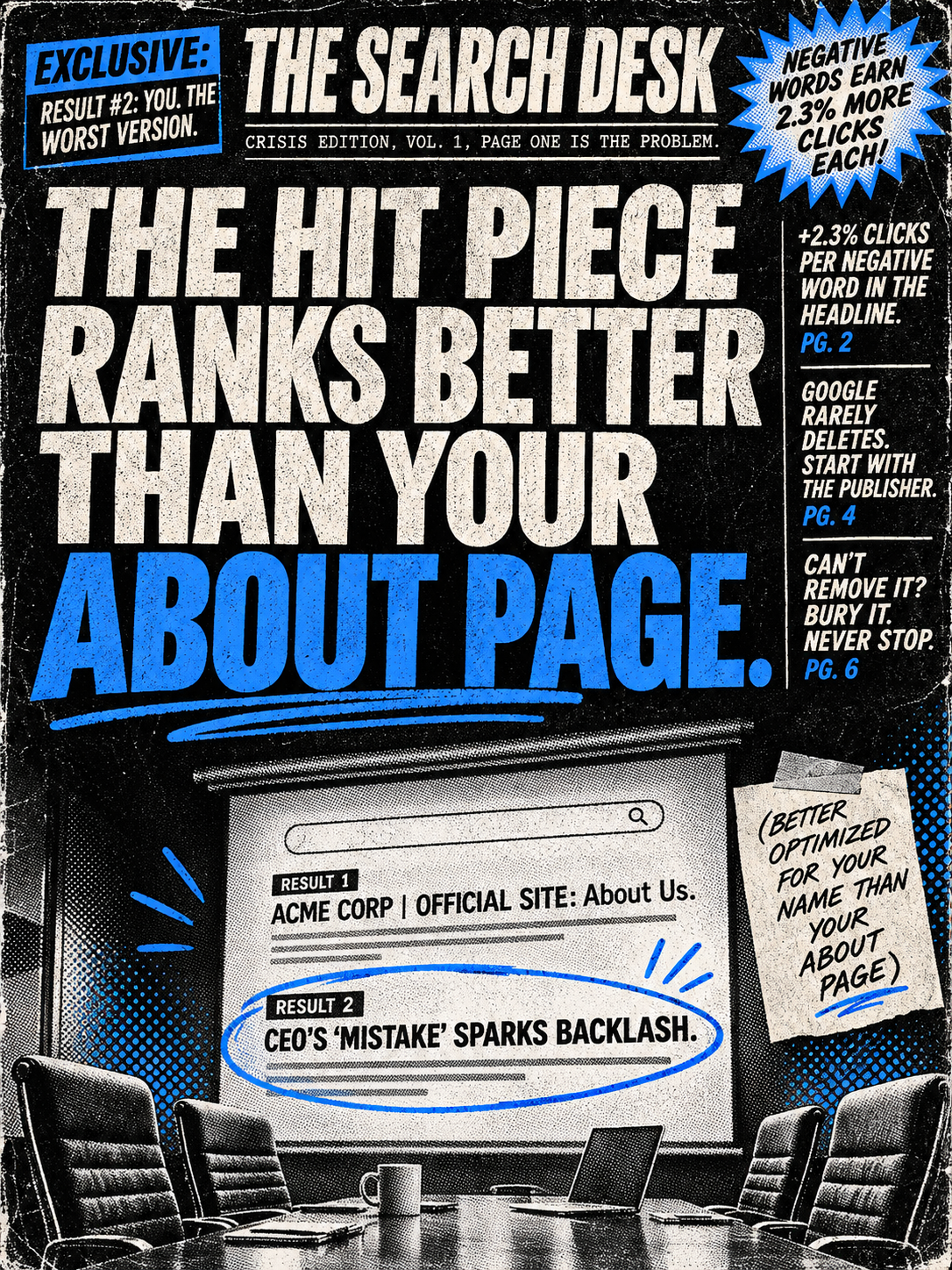
Every crisis management meeting I’ve ever sat in has the same moment.
Someone shares their screen. Types the CEO’s name into Google. Hits enter.
And the whole room goes silent while the page loads, like we’re waiting for a jury verdict.
Then there it is. Result number two. The article. Sitting right under the company website, with a headline someone clearly had fun writing.
That silence is the real crisis. Not the original mistake, not the angry posts. It’s the fact that anyone who searches for you (clients, investors, that candidate you’re trying to hire) now meets the worst version of you first. So let’s talk about what actually works when you need to remove negative articles from Google, and what to do when you can’t.
Why Negative Press Dominates Your Search Results
Rude but true: Google isn’t punishing you. It’s just doing its job really, really well. At your expense.
As Martech explains, negative articles tend to include your name in the title, URL, and headline, making them a near-perfect match for anyone searching you, and the clicks and attention they collect help keep them ranking.
Let me translate this for you: that hit piece is better optimized for your name than your own About page. (I’ve watched founders process this in real time. It’s like finding out your nemesis has better skin than you.)
And people love bad news. Not in a dramatic way. In a measurable, peer-reviewed way. Research published in Nature Human Behaviour found every extra negative word in an average-length headline increased click-through rates by 2.3%. Here’s the full study if you want to lose a little more faith in humanity.
So the negative press matches your name, people click it, the clicks keep it near the top. And round and round we go.
How Social Media Turns One Mistake Into a PR Crisis
Then social media walks in carrying gasoline.
Every platform pays people in reactions. Refreshing a feed gives the same little dopamine pull as a slot machine, and the jackpot is engagement. The fastest way to get engagement? Make people angry.
So people get rewarded for outrage, and a mistake (even a small, honest, we-already-apologized-in-the-group-chat mistake) turns into a dogpile. Then news sites spot the traffic and publish clickbait to grab their share. Now it’s a story. Now it’s in your search results. Now it’s a crisis.
(This is usually the point where someone on the team says “maybe it’ll blow over.” Sometimes it does! But hoping isn’t a crisis management strategy.)
Should You Respond to Negative Press? A Crisis Management Gut Check
Before you touch ANYTHING, answer one question honestly:
𝘐𝘴 𝘵𝘩𝘪𝘴 𝘩𝘶𝘳𝘵𝘪𝘯𝘨 𝘵𝘩𝘦 𝘣𝘶𝘴𝘪𝘯𝘦𝘴𝘴, 𝘰𝘳 𝘪𝘴 𝘪𝘵 𝘩𝘶𝘳𝘵𝘪𝘯𝘨 𝘮𝘺 𝘧𝘦𝘦𝘭𝘪𝘯𝘨𝘴?
Both are valid. Only one needs a response. Emotional reactions are how a post with forty readers becomes a post with forty thousand, because you jumped into the comments with a paragraph that started with “To be clear...”
What they meant to say was: sometimes the best crisis management move is strategic silence.
Act if the coverage is showing up when people search you, costing you deals, scaring off talent, or spreading. If it’s buried on some forgotten blog nobody reads, let it sink on its own. And if you do respond, here’s how to handle reputation management after bad press without making it worse.
Can You Remove Negative Articles from Google? Here’s What Actually Works
Sometimes, yes. But not the way “we’ll make it disappear, guaranteed!” agencies in your inbox are promising.
According to defamation attorneys at Revision Legal, 𝘎𝘰𝘰𝘨𝘭𝘦 𝘨𝘦𝘯𝘦𝘳𝘢𝘭𝘭𝘺 𝘸𝘰𝘯’𝘵 𝘵𝘢𝘬𝘦 𝘢 𝘯𝘦𝘸𝘴 𝘢𝘳𝘵𝘪𝘤𝘭𝘦 𝘰𝘶𝘵 𝘰𝘧 𝘴𝘦𝘢𝘳𝘤𝘩 𝘳𝘦𝘴𝘶𝘭𝘵𝘴 𝘫𝘶𝘴𝘵 𝘣𝘦𝘤𝘢𝘶𝘴𝘦 𝘪𝘵’𝘴 𝘶𝘯𝘧𝘭𝘢𝘵𝘵𝘦𝘳𝘪𝘯𝘨 𝘰𝘳 𝘰𝘭𝘥. The most effective approach is asking the publisher to remove, update, or anonymize it, then using Google’s Refresh Outdated Content tool so search catches up. Content a court has ruled unlawful can go through Google’s Legal Help Center.
So the real removal playbook is:
- Start with the publisher. Be polite and factual. Flag errors, outdated details, or why your name doesn’t need to be in it anymore. Editors update stories more often than people expect.
- Refresh the result. Once the article is changed or gone, ask Google to update the listing so the old headline stops haunting you.
- Get legal help if it’s truly unlawful. Defamation has formal routes. Talk to a lawyer before sending angry emails with the word “sue” in them.
Now for the tea. Search Engine Journal reported that an article that had survived legal challenges was later wiped from Google through repeated abuse of the Refresh Outdated Content tool. Someone found a loophole. It became a news story of its own.
Which is the whole lesson. Shady shortcuts don’t end a crisis. They gave it a sequel.
And here’s the part nobody likes hearing: removing false information from the internet is often harder than simply outranking it.
How to Push Down Negative Search Results With Reputation Management
If you can’t delete it, you bury it. That’s the backbone of reputation management: create so much credible, relevant content that the bad article sinks below it.
What that actually looks like:
- Publish content people genuinely want. Articles, guides, interviews, profiles, anything useful to someone searching your name or company. Obvious puff pieces convince nobody, Google included.
- Use keywords like a human. Put your name and brand where they belong, mix in variations, and write naturally. Keyword stuffing looks exactly as desperate as it sounds.
- Earn links from sites people trust. Guest posts, podcast spots, media features. Credible links tell Google your positive content deserves to rank. (Buying links gets you penalized. Please don’t.)
- Never stop. Fresh content keeps old content sinking. Go quiet and the bad article floats right back up like a pool noodle.
This is where real PR pulls its weight. Media coverage puts trusted sites on your side of the search results, which is exactly why thought leadership earns you press coverage that actually lasts.
If this sounds like a second job, that’s because it is. Bringing in content and SEO pros lets someone else rebuild your reputation behind the scenes while you get back to running the company.
How to Build a Crisis Management Plan Before the Next Headline Hits
The article’s down (or pushed to page three, where nobody looks). Congrats. You’re not done.
Anyone can write another one. Old stories resurface at the worst possible moments. So the final piece of crisis management is making sure the next hit doesn’t land as hard:
- Monitor your search results. Google yourself regularly. Set alerts. Find out before a client forwards it to you with “???”
- Write a crisis management plan. Who responds, who approves statements, what you’ll say, and what you will NEVER say. Do it while you’re calm, not at midnight with your heart pounding.
- Keep publishing quality content. The more strong pages you already have ranking, the harder it is for anything negative to crack the top results.
- Build trust before you need it. Brands people already believe in recovering faster, which is why brand trust is quietly rewriting how PR works.
Good crisis prep is boring. That’s the point. Boring preparation is what lets you stay calm while everyone else panics.
Crisis Management Is How You Take Your Name Back
Crisis management isn’t about pretending nothing happened. It’s about deciding what people find when they go looking.
Go to the publisher first. Use the tools that actually exist. Skip the sketchy shortcuts. Then build such a strong wall of credible content that your worst headline becomes a footnote nobody scrolls far enough to see.
You can’t control what gets written about you. You can control what shows up first.
Don’t Be A Little Pitch helps brands make sure the first thing people find is the right thing. If your search results are telling the wrong story, let’s rewrite it.
FAQ
What is crisis management in PR?
Crisis management is how a business prepares for, responds to, and recovers from events that could damage its reputation, such as negative press, public mistakes, or social media backlash. It includes communication plans, response strategies, and steps to rebuild trust afterward.
What should a crisis management plan include?
A crisis management plan should include who is responsible for responding, who approves public statements, key messages, contact lists for media and stakeholders, guidance for social media, and a process for monitoring coverage and search results.
Can you remove a negative news article from Google?
Google usually won’t remove a news article just because it’s negative. The most effective step is asking the publisher to remove, update, or anonymize it. Once the article changes, you can request an update through Google’s Refresh Outdated Content tool. Content ruled unlawful by a court may qualify for legal removal.
How do I push down negative search results?
Create high-quality content about yourself or your business, such as articles, interviews, profiles, and media coverage. Earn links from reputable websites and publish consistently so positive pages rank above the negative ones.
What’s the difference between crisis management and reputation management?
Crisis management focuses on responding to a specific damaging event as it happens. Reputation management is the ongoing work of shaping how people perceive you, including monitoring search results, creating positive content, and addressing negative press over time.
Should a business respond to negative press?
It depends on how much impact the coverage is having. If it’s affecting customers, sales, or search results, a calm and factual response can help. If it has little reach, responding may draw more attention to it.


60-Day Performance Guarantee
PR only works if it builds momentum fast. If we do not secure 2 meaningful earned media features and line up 3 additional opportunities within 60 days, you get a full refund.

Free Authority Score Checker
Check your online reputation and authority score for free and see how you stack up and get custom tips to improve instantly.