Why Your Earned Media Strategy Is Broken (And What's Actually Working Now)

TLDR:
- Your earned media strategy is probably built on habits that stopped working two years ago and nobody told you.
- 88% of journalists delete pitches immediately if they don't match their beat. A better subject line is not going to save you.
- Publishing more with nothing new to say is not a PR strategy. It is a very organized way to be ignored.
- The brands getting media coverage right now have a real person with a real opinion attached to every pitch. That is the whole secret.
- Volume is dead. Specificity is the only thing that works. Welcome to 2026.
.png)
A brand came to us last year with a debrief document they were genuinely proud of.
Three hundred pitches sent. Fourteen replies. Thirteen were out-of-office auto-responses.The slide deck concluded that the subject line needed more A/B testing.
This triggered something in me. Not because the numbers were surprising we see this more than we should but because a whole room of people looked at that report and decided the subject line was the variable worth optimizing. Not the targeting. Not the angle. Not the fact that the pitch could have belonged to any brand in the category without changing a noun.
That is the thing about earned media in 2026. It is not going to be polite about this anymore. The media coverage landscape did not shift gradually, the way you could track it on a graph and course-correct at the quarterly review. It narrowed. Hard. Fast. Quietly. Like someone turned the dial on relevance and forgot to send the update.
According to Muck Rack's 2026 State of Journalism, 88% of journalists immediately delete pitches that don't match their beat. Not skim. Not file for later. Delete. And 54% say they seldom or never respond to pitches at all. Which means more than half the emails that team sent went directly to trash before anyone registered the brand name.
Three hundred pitches. One genuine reply. And a slide deck that blamed the subject line..
Why Your Current PR Strategy Is Killing Your Media Coverage
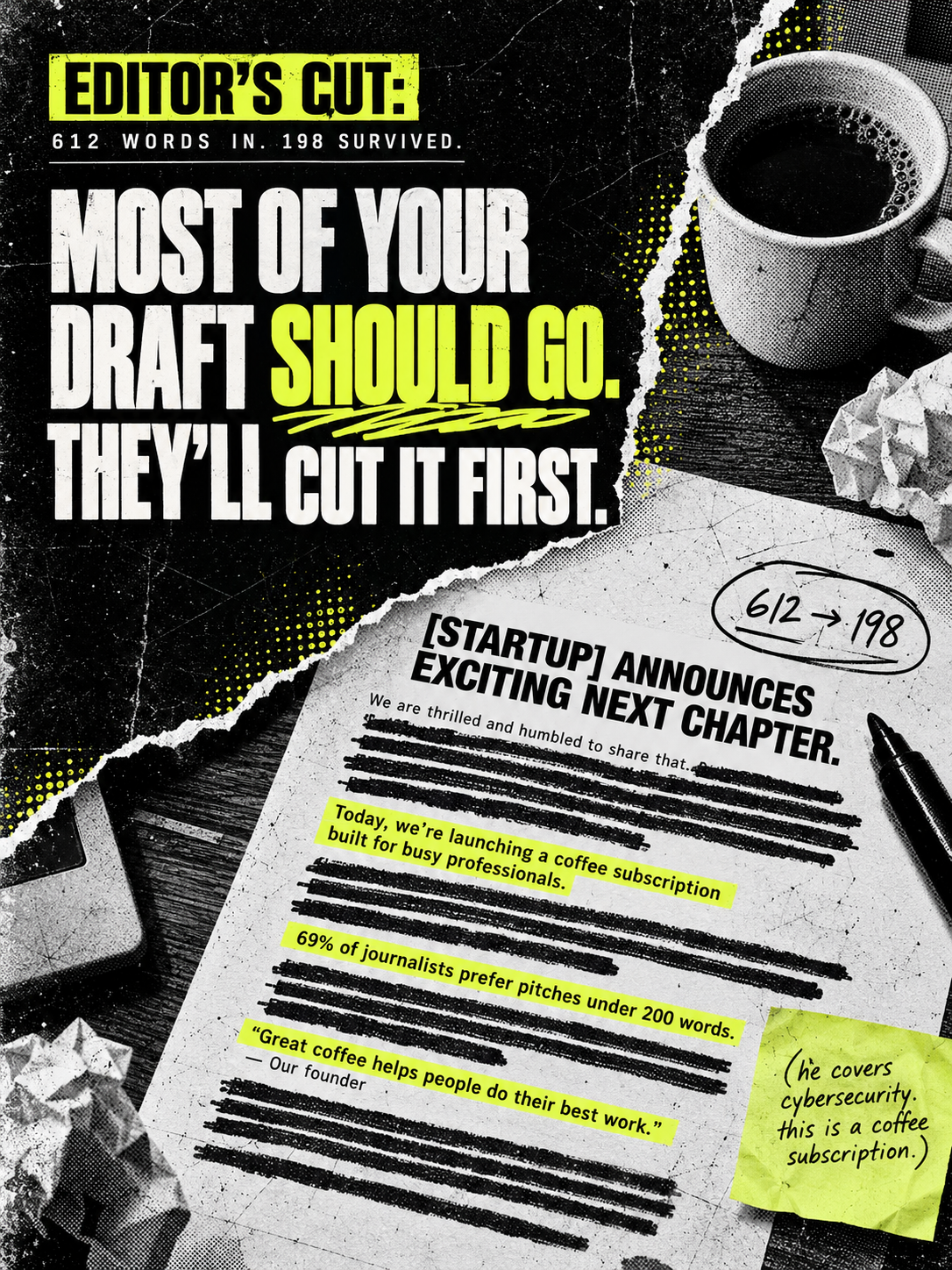
The first thing that is dead is the generic press release. Not press releases as a format, the generic one. The one that opens with "we are thrilled to announce" and could have been sent by any of your competitors without changing a single noun. If a journalist cannot tell within the first sentence who sent this and why it matters to their specific audience today, it is not a pitch. It is a plea. And journalists can smell a plea before they finish reading the subject line.
I used to sit in meetings where we spent three weeks wordsmithing a release that had no angle, no named source with an actual opinion, and no real reason to exist beyond the fact that a product launched. We circulated it for approval like it was a legal document. We sent it to 400 journalists. We followed up twice.
Who approved this and are they okay???
The Cision 2025 State of the Media report found that the average journalist receives 50 pitches a week and only 2% want anything longer than 400 words. PR Agenciesbuilt careers on 600-word pitches with "robust context." They were the noise. They wrote the noise. They approved the noise. And somewhere in a newsroom, a reporter on deadline was scrolling past us so fast she didn't register the brand name.
The second thing that is over is publishing volume as a substitute for having something to say. The Reuters Institute 2025 Digital News Report found that 40% of people worldwide now actively avoid the news at least sometimes, up from 29% in 2017. And there are brands out there right now scheduling their twelfth announcement of the quarter thinking sheer frequency is going to move the needle.
It is not. It has not. It will not.“
Volume without a point of view is not a PR strategy. It is a very organized way to be invisible.
”The third is trend-chasing with no perspective attached. The brand that sees a cultural moment happening, jumps in with "we're leaning in," and then leans directly into a silence so loud you can hear the engagement chart flatline. This triggered something in me, because I have watched this happen across multiple agencies with multiple clients and the result is always the same: a post that goes nowhere, a team that congratulates itself for being "timely," and a journalist who never opens the email.
What Earned Media Actually Looks Like
The brands getting media coverage right now share one thing in common. They are saying something. Not issuing a committee-approved statement taking an actual stance. A founder going on record with a real opinion about something happening in their industry travels further and faster than any press release. Edelman's Trust Barometer confirmed that 60% of consumers trust a person talking about a brand more than the brand talking about itself. You could have saved an entire decade of budget on that finding alone.
People trust people. Editors want names attached to perspectives. A founder with genuine conviction does the work that used to require a fifteen-person approval chain and a publicist on speed dial. The era of the faceless corporate voice in earned media is over. We just kept paying for it long after the data stopped supporting it.
The other thing working right now is cultural timing which is different from trend-chasing, and the distinction matters more than most teams realize. Trend-chasing is your brand hearing a cultural conversation and jumping in because the hashtag is moving. Cultural timing is your brand having something real to contribute to a moment that genuinely connects to what you do or believe. If you would still have a perspective on this topic after the trend dies, that is timing. If the answer is no, that is noise.
“The era of the faceless corporate voice in earned media is over.”
Media pitching that actually earns coverage in 2026 looks like this: one specific angle, a named person with a perspective, a clear connection to something happening right now, sent to a journalist whose beat actually covers it. That is the whole formula. We spent years making it more complicated than that because complicated felt more like work.
If you want to understand how to position your brand so journalists actually want to hear from you, The PR Glow-Up breaks down exactly what that repositioning looks like without starting from scratch. And if you have never fully understood what a journalist is looking for when they open a pitch, What to Expect When You're Expecting Media Coverage covers that in the kind of detail nobody in your onboarding ever did.
The Brands Getting Covered in 2026 Are Not Doing More.
The earned media landscape is not hostile to brands. It is just finally honest about what earns attention and what does not. It rewards clarity, specificity, and a real human perspective attached to a timely angle. It ignores everything else with remarkable, borderline therapeutic efficiency.
The PR strategy that works in 2026 is not louder, not more frequent, not more automated. It is clearer. Specific. Attached to a real human with an actual opinion on something that matters right now. Which is, incidentally, what good media pitching always was before we started optimizing our way out of it.
I'm closing my laptop now.
Your story deserves better than a trash folder. Don't Be A Little Pitch builds earned media strategies that actually get covered. See how we do it.
FAQ
Why is my earned media strategy not getting results?
Most earned media strategies fail for one of three reasons: the pitch is not relevant to the journalist's beat, the angle is brand-first instead of story-first, or there is no specific human perspective attached to it. Relevance and specificity are the two variables that actually determine results. Volume, follow-up frequency, and subject line length are not.
Is the press release completely dead?
No. The generic press release is dead. If your announcement could belong to any brand in your category, no journalist wants it. If it has a specific angle, a named source with a real opinion, and tells a reporter something genuinely new about something they actively cover, it still works. The format is not the problem. The blandness is.
How do I get media coverage without a large PR budget?
Identify three to five journalists who actually cover your category. Read their last ten articles. Build one specific angle that connects your brand to something they are already writing about. Pitch that angle with a named source attached who has an actual opinion. One strong, targeted pitch beats fifty generic ones every time. That process costs time, not money. It is also how brands with no budget consistently outperform ones with full retainers.
How do I know if my pitch angle is strong enough to send?
Ask yourself two questions. First: could this angle be sent to 50 other journalists with only the name changed? If yes, it is not ready. Second: does it answer "why does this matter to this journalist's specific audience today"? If you cannot answer that in one sentence, neither can the journalist. Fix those two things before you hit send.
What does good media pitching look like in 2026?
Good media pitching in 2026 is short, specific, and sent to the right person. It leads with the story angle, not the brand announcement. It has a named source with a real perspective attached. It connects to something happening in the world right now. And it arrives in the inbox of a journalist who actually covers that topic. That is it. Everything else is noise.
60-Day Performance Guarantee
PR only works if it builds momentum fast. If we do not secure 2 meaningful earned media features and line up 3 additional opportunities within 60 days, you get a full refund.

Free Authority Score Checker
Check your online reputation and authority score for free and see how you stack up and get custom tips to improve instantly.




.png)