Media Pitching: Why Journalists Ignore Perfect Pitches and What Actually Works

TLDR:
- Most people don't send bad pitches. They send forgettable ones, polished to death and terrified of saying anything real.
- Media pitching that works is raw, specific, and timed right. Safe is the actual career killer here.
- Journalists respond to roughly 3.43% of pitches. Your polish isn't the problem. Your lack of humanity is.
- Read this before you send another pitch that disappears into the void.
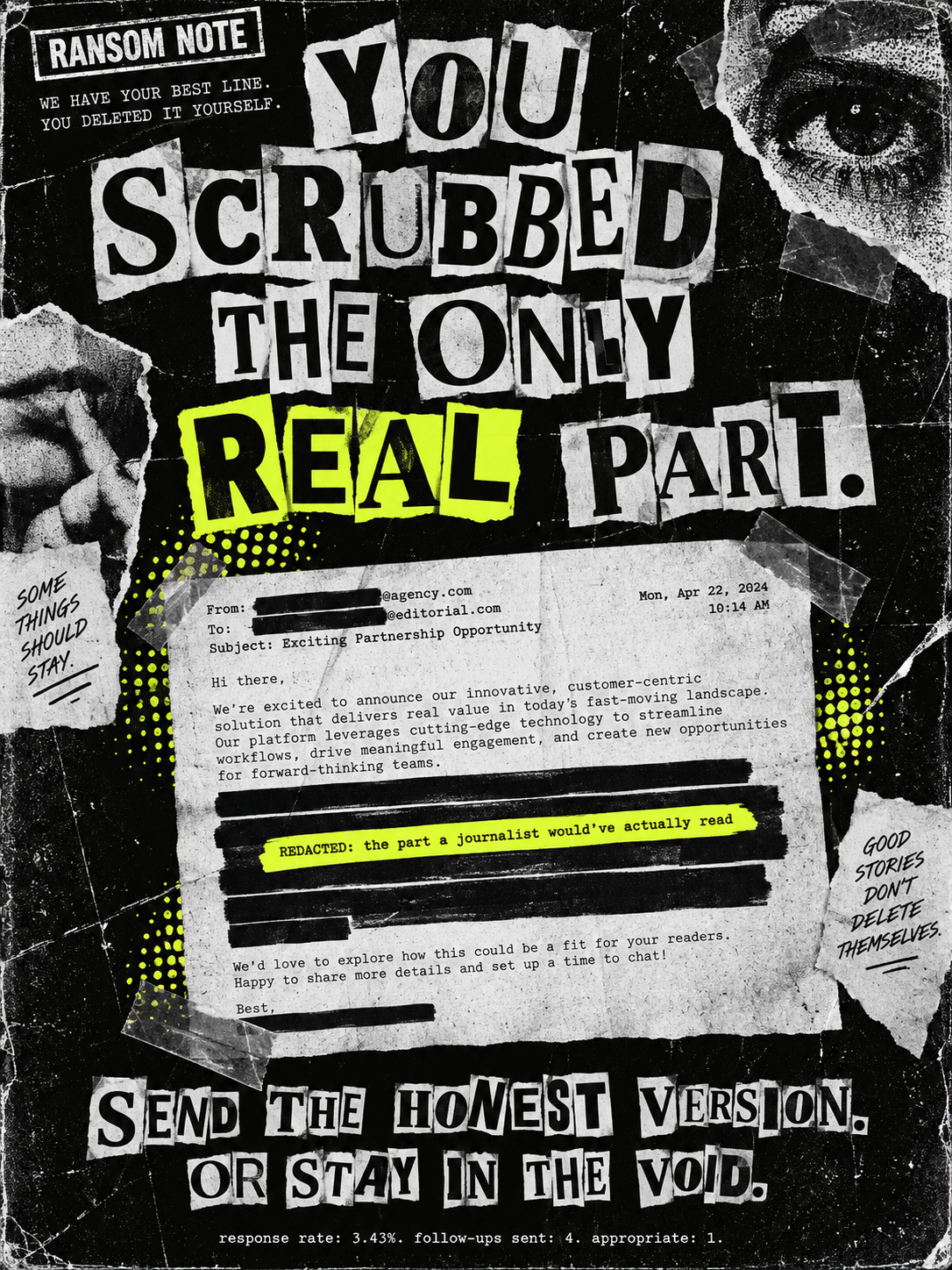
Most people don't send bad pitches. They send forgettable ones.
You know the type. Polished to death, loaded with buzzwords, and completely terrified of saying anything remotely real. Somewhere along the way, the PR world decided that safety equals strategy. That if you play it safe, you stay in the game.
Here's what that actually costs you: media pitching that plays it safe gets ignored. Every time.
Why Journalists Are Ignoring Your PR Pitch
The inbox situation is brutal and it's getting worse. According to Muck Rack's State of Journalism report, 49% of journalists seldom or never respond to pitches, and nearly three quarters reject pitches purely because they don't align with the journalist's coverage area. Nearly half are receiving six or more pitches every single workday.
That's not a crisis of bad writing. That's a crisis of sameness.
Every pitch sounds like the last one. Every brand story is told in the same corporate voice, with the same buzzwords, and the same terrified energy of someone trying desperately not to offend anyone. The result: a pitch that offends no one and interests no one.
Journalist outreach that actually works doesn't sound like everyone else's. It sounds like a real person who has something specific to say and the conviction to say it without softening every edge first.
Raw and Honest Media Pitching Outperforms Polished Every Time
The pitches that land aren't always the most clever or beautifully constructed. They're the ones that feel human: unfiltered, honest, and occasionally a little messy.
Marcus Denning, a legal practitioner at MK Law, puts it plainly: "Journalists prefer raw and honest perspectives because they feel more genuine and relatable to their audience."
This isn't a call to overshare for shock value. It's about owning the parts of your story that aren't tied up in a bow. The most compelling PR pitch narratives are the ones where someone shows up, flaws and all, and says: here's what actually happened. No spin. No corporate buffer. Just the real version.
That's what gets read. That's what gets replied to. That's what gets published.
Stop Scrubbing the Good Parts Out of Your Pitch
One of the most common media pitching mistakes happens right before hitting send. Panic creeps in. The parts of the story that show struggle, risk, or discomfort get deleted. The pitch becomes safe, smooth, and completely forgettable.
Elizabeth Lawrence, Managing Editor at MAGA.com, is direct about it: "I can't stand pitches that try to cover up the truth or sound like corporate fluff. I've seen too many pitches that focus solely on promoting something without addressing the real, often uncomfortable issues that might be involved."
The parts of your story that feel too bold? Those are probably the parts worth keeping. If something is uncomfortable but true, it belongs in the pitch. That's what makes it credible. Knowing what makes your PR pitch land starts with refusing to sand down everything that gives it texture.
Playing it safe just makes you sound like everything else already sitting in that inbox.
Media Pitching Timing Is Just as Important as the Message
Here's the hard truth most people overlook: even the best PR pitch will flop if it lands at the wrong moment.
People obsess over crafting the perfect message and completely forget about the moment it arrives. Ford Smith, Founder and CEO of A1 Xpress, explains it through a logistics lens that maps perfectly onto pitching:
"In the early days, we'd show up early, thinking we were offering great service. But more than once, I heard from clients who were frustrated because we were too early. They didn't have room to store what we dropped off, or the right people weren't available to handle it. That's when I realized: speed alone isn't enough. It's about timing. I see the same thing happen with pitches. My inbox is full of pitches that aren't bad at all, but they're mistimed. The pitch itself isn't the issue. It's when it hits."
A media pitching strategy without timing awareness is just a volume strategy. And volume, as the data shows, isn't working. According to the PR Pitch Response Rate Study 2026, journalists respond to just 3.43% of pitches, and a short pitch generates four times the response rate of a long one. Relevance and timing beat length and polish. Full stop.
How to Write a PR Pitch That Gets a Response
The media pitching mistakes that quietly end PR careers all come back to the same root cause: prioritizing the brand's comfort over the journalist's actual needs.
Here's what shifts the outcome:
Lead with the uncomfortable truth. If your story has a real, honest, human angle that's slightly uncomfortable, that's your hook. Don't bury it. Lead with it.
Match the journalist's actual beat. Cision's State of the Media research found that three quarters of journalists only find value in 25% or fewer of the pitches they receive. The biggest reason for rejection is irrelevance. Know who you're pitching before you write a single word.
Keep it short. A short pitch generates four times the response rate of a long one. If you can't explain the story in under 200 words, you don't understand the story yet.
Time it right. A pitch that arrives before a journalist is even thinking about your topic, or long after they've moved on, is invisible regardless of how good it is. Their world matters more than your send schedule.
Stop following up repeatedly. 62% of journalists say only one follow-up is appropriate, and 24% of US-based reporters say never follow up at all. One follow-up, done. Move on.
Safe Isn't a Strategy. It Never Was.
Most people aren't getting ignored because their media pitching is bad. They're getting ignored because it's boring.
Safe doesn't make anyone lean in. Safe doesn't spark curiosity. Safe doesn't get you coverage. In a media landscape where journalists are receiving more pitches than ever while working with fewer resources than ever, safe is essentially invisible.
Stop worrying about templates and flawless subject lines. Start telling the truth, even when it's uncomfortable. Make sure your timing makes sense for their world, not just yours. And stop scrubbing away the parts of your story that actually make it worth telling.
That's how you stop being forgettable.
Most brands know they need a better PR pitch strategy. Few know where the actual gaps are. Don't Be A Little Pitch was built for exactly that conversation.
FAQ
Why do journalists ignore most PR pitches?
The most common reason is irrelevance. Nearly three quarters of journalists reject pitches that don't match their coverage area. Pitches that sound corporate, overly polished, or committee-written don't get read because they don't feel worth reading. Journalists are busy and they can spot a mass-blast pitch immediately.
What makes a PR pitch actually work?
Specificity, honesty, and timing. A pitch that leads with a real, human angle, speaks directly to what a specific journalist covers, and arrives when they're actually receptive to that topic will always outperform one that's just well-formatted. Relevance is the deciding factor above everything else.
How long should a media pitch be?
Short. Under 200 words if possible. Behavioral data from an analysis of 400,000 real pitches shows that short pitches generate four times the response rate of long ones. If you can't explain the story in a few short paragraphs, it needs more editing, not more content.
How many times should I follow up on a pitch?
Once. Current journalist surveys show 62% say one follow-up is appropriate, and nearly a quarter say never follow up at all. Multiple follow-ups don't increase your chances. They increase the likelihood of getting blocked. Send one follow-up and move on.
What's the biggest media pitching mistake brands make?
Stripping out anything that feels uncomfortable or bold before sending. The parts of a story that feel slightly risky are usually the most interesting parts. Over-polishing a pitch removes exactly what would make a journalist stop and read it. The goal isn't to sound safe. The goal is to sound worth a reply.

60-Day Performance Guarantee
PR only works if it builds momentum fast. If we do not secure 2 meaningful earned media features and line up 3 additional opportunities within 60 days, you get a full refund.

Free Authority Score Checker
Check your online reputation and authority score for free and see how you stack up and get custom tips to improve instantly.




.png)