What a Real PR Pitch Hook Looks Like

TLDR
- Personalization is not a find-and-replace job. If the only thing separating your pitch from the last one you sent is the name at the top, journalists clock it immediately.
- "We're excited to announce" tells the journalist nothing except that you ran out of ideas in the first four words. Lead with the reason the story matters to their readers right now, not the reason it matters to your CEO.
- Only 7% of journalists find the pitches they receive relevant more than half the time. That is not a journalist problem, that is a pitching problem.
- "We'd love to be featured in Forbes" is not a strategy, it is a wish list. Pick fewer outlets, understand what each one actually covers, and build a specific angle for each.
- Run the swap test before you hit send. Replace your company name with a competitor's and read it again. If the pitch still makes sense, you do not have a hook, you have a template, and templates are why journalists stopped opening your emails in the first place.

The first sign you do not have a PR pitch hook is that your pitch feels productive to send.
It feels productive because it has a structure. It has paragraphs. It has a company logo in the footer and a subject line that took twelve minutes to write. You have a spreadsheet with 47 names and a column called "personalized." You hit send and you feel like you did the thing.
You did not do the thing.
I know this because I was doing it for years. Confidently. Repeatedly. With a straight face and a color-coded media list that I genuinely believed was a competitive advantage.
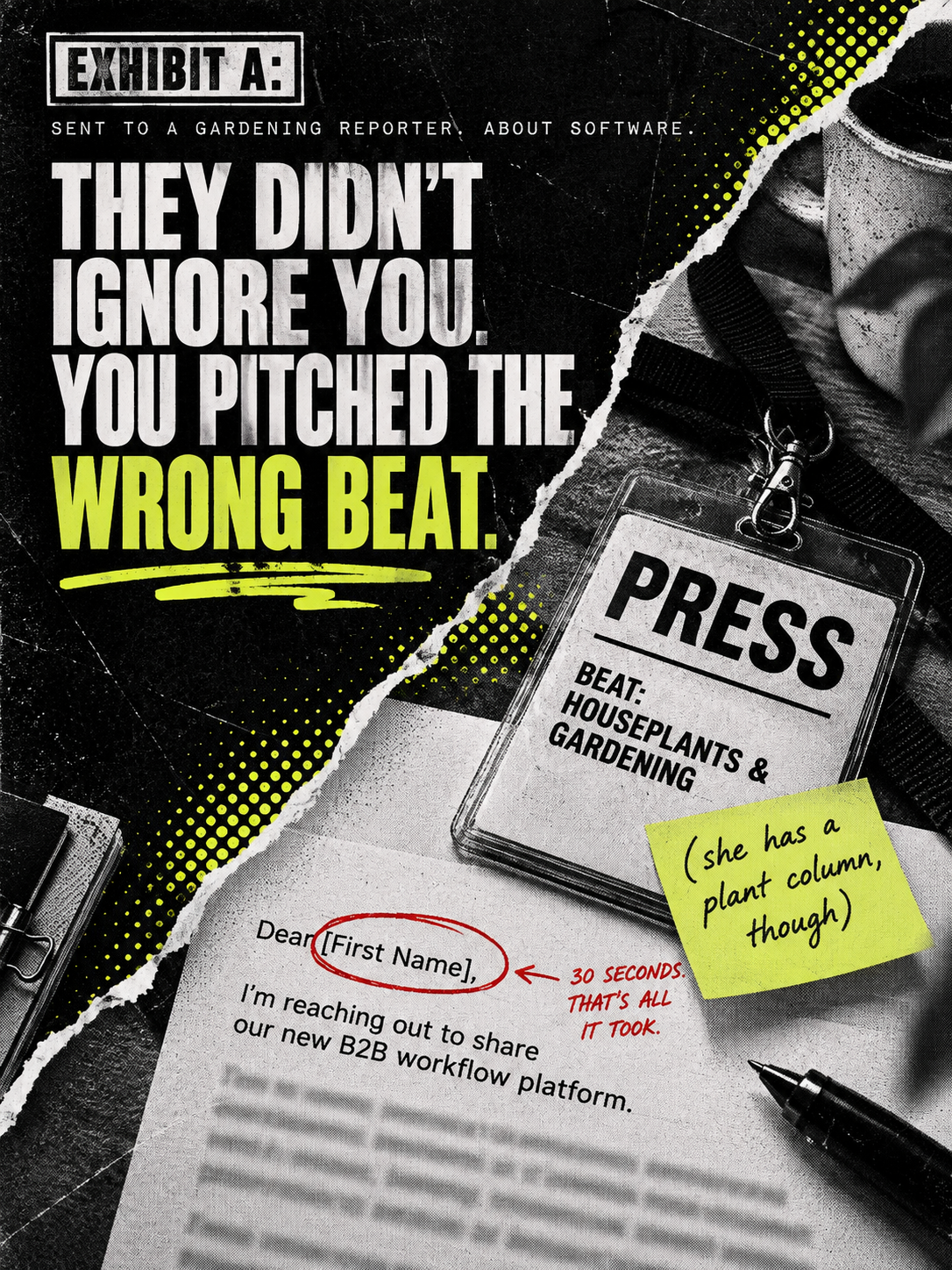
I found one of my old pitches recently and I want to describe it for you. It opened with "We're excited to announce." The journalist's name appeared once, in the salutation, and there were still brackets around it because I forgot to remove the template markers before sending. It said "[Journalist Name]."
I sent it to 47 people. I felt great about it.
The pitch was dead before it landed. Cookie-cutter pitches are dead. Mine just had not gotten the memo yet.
Why PR Pitches Get Ignored
Inbox fatigue is the very polite name for the ecosystem I was contributing to. Here is what that ecosystem actually looks like by the numbers:

I had been sending pitches for years. I was a card-carrying member of the 93% problem and had absolutely no idea. The strategy meetings did not help. I used to sit in those rooms where someone would say "we'd love to be featured in Forbes" and the whole table would nod like this was a plan.
As if the journalist was simply waiting for someone to express a desire. As if wanting coverage and having a reason for coverage were the same thing.
They are very much not the same thing.
What Journalists Actually Want in a Pitch
I also had a system for personalized media outreach that I want to formally apologize for. The system was: change the name at the top, swap one sentence about a recent article the journalist had written, and send the rest completely identical to every other pitch on the list.
A mail merge with ambition and nothing else.
Here is what my inbox-fatigue-inducing pitch looked like versus what an actual PR pitch hook looks like:

Muck Rack analyzed over 5 million email pitches. Actually personalized pitches got opened 55% of the time. Mass spray got 37%. And an analysis of 400,000 pitches from 2024 found reporters respond to only 3.27% of what they receive.
Open rates are not wins. Nearly half of journalists opened my emails. Fewer than four in every hundred responded. The pitch got in the door and immediately said nothing worth responding to.
Cookie-cutter pitches are dead. Mine just kept walking around like everything was fine.
How to Build a Media Hook Journalists Care About
A PR pitch hook is not your product. It is not your launch. It is not the thing your CEO typed into a Google doc at 11pm and called "messaging."
It is the specific, timely angle that makes your story relevant right now to this journalist's particular audience. Not to your brand. Not to your board. To the actual humans who read the outlet you are pitching, on the day you are pitching it.
Most pitches fail because they are written from the wrong seat entirely. "We're excited to announce" is brand language. "Our company is disrupting" is brand language. "We'd love to be featured" is not language at all. It is a wish with a subject line
If you want to see what it actually looks like when a brand gets this right, the PR Glow-Up piece covers that territory in a way worth reading before your next pitch.
How to Write a Pitch Journalists Will Open
Before you pitch anything, three questions actually matter. Most people skip the first one. The first one is the whole game.
1. What conversation is already happening in the world right now that your story connects to?
2. Where does your insight add something genuinely new to that conversation
3. Why now specifically, and not just because the press release is finally finished?
If you cannot answer question three with something other than "because we finished the press release," you do not have a hook. You have a calendar event dressed up as a media strategy.
The shift is from "what do we want to say" to "what would make this journalist look smart for covering us." Those are different questions with very different answers. One of them gets responses. The other one gets archived.
What a PR Pitch That Gets a Response Actually Looks Like
Personalized media outreach beats automation. Insight beats announcements. Relevance beats reach, every single time, without exception.
Your media list size does not matter. The CRM you use does not matter. The logo in the email footer has never mattered and will never matter. What matters is whether the person who opens your email understands, within the first two sentences, exactly why this story belongs in front of their readers right now.
Here is a quick gut-check before you hit send:
- Could you swap your company name with a competitor's and have the pitch still make sense? If yes, you have a template, not a hook.
- Does your subject line tell the journalist what is in it for their readers, or just what is in it for you?
- Is "why now" answered anywhere in this pitch, or did you just assume the launch date counted?
- Did you actually read this journalist's last three articles, or did you read their bio and call it research?
If your PR pitch hook is not passing that gut-check, you are in the 93% causing inbox fatigue. You are the opened email that still gets archived. Cookie-cutter pitches are dead, and unfortunately yours is one of them.
Your pitch is not a strategy. It is a symptom. Don't Be A Little Pitch exists for exactly this reason, and we are not going to be gentle about it.
Frequently Asked Questions
What is actually the difference between a pitch and a PR pitch hook?
A pitch is the container. The PR pitch hook is the reason the container has anything worth opening. Your pitch is the email format, the structure, the press kit link at the bottom. The hook is the specific, timely angle that answers why anyone should care about this right now. You can write a beautifully formatted pitch with zero hook. Most people do. And once the pitch starts landing, you will want to know if your PR is actually working so you can double down on what is hitting.
How do I know if my pitch is causing inbox fatigue?
Run the swap test. Take your pitch and replace your company name with a competitor's. If it still makes total sense, you do not have a hook, you have a template. Inbox fatigue is what happens on the journalist's end when their inbox fills up with pitches that could have come from anyone about anything. If yours could have come from anyone, that is the diagnosis.
Can I do personalized media outreach at scale, or does it only work one pitch at a time?
You can build systems that get you closer to real personalization. But be honest with yourself about what "scale" is actually doing here. Real personalized media outreach means you read the journalist's recent work, you understand their beat, and you built an angle specifically for them. That is not a volume play. That is a targeting play. Pick fewer journalists, pitch them properly, and stop treating the BCC list like it is a strategy.
My boss is asking for 100 journalist contacts per campaign. What do I do with this information?
Reach 100 journalists with one genuinely good PR pitch hook that is relevant to each outlet you target. That is different from sending 100 identical emails. How to pitch journalists at scale without losing your mind means doing serious research upfront on your angle and your targets so the pitch work downstream is accurate and fast, rather than just fast.
What if the story really is just a product launch? Is there even a hook in there somewhere?
Almost always yes, but you have to dig past the launch itself. The launch is evidence. The hook is the reason the evidence matters right now. What problem does the product solve, and why is that problem showing up in the news? What does it change for the people who need it most? That tension is your PR pitch hook. The launch just proves you built something about it.


60-Day Performance Guarantee
PR only works if it builds momentum fast. If we do not secure 2 meaningful earned media features and line up 3 additional opportunities within 60 days, you get a full refund.

Free Authority Score Checker
Check your online reputation and authority score for free and see how you stack up and get custom tips to improve instantly.




.png)