Personal Branding Starts With Googling Yourself (And Most of You Have Never Done It)

TLDR:
- You sent a flawless cold email. They Googled you anyway. They always do.
- Personal branding doesn't start with a logo or a tagline. It starts with what shows up when someone searches your name. Wild that this needs saying.
- If your search results show a stranger, an old yearbook photo, or nothing at all, congratulations, you don't exist.
- Your online presence is either working for you right now or quietly working against you. There is no neutral option, and no, "I haven't checked" doesn't count as neutral.
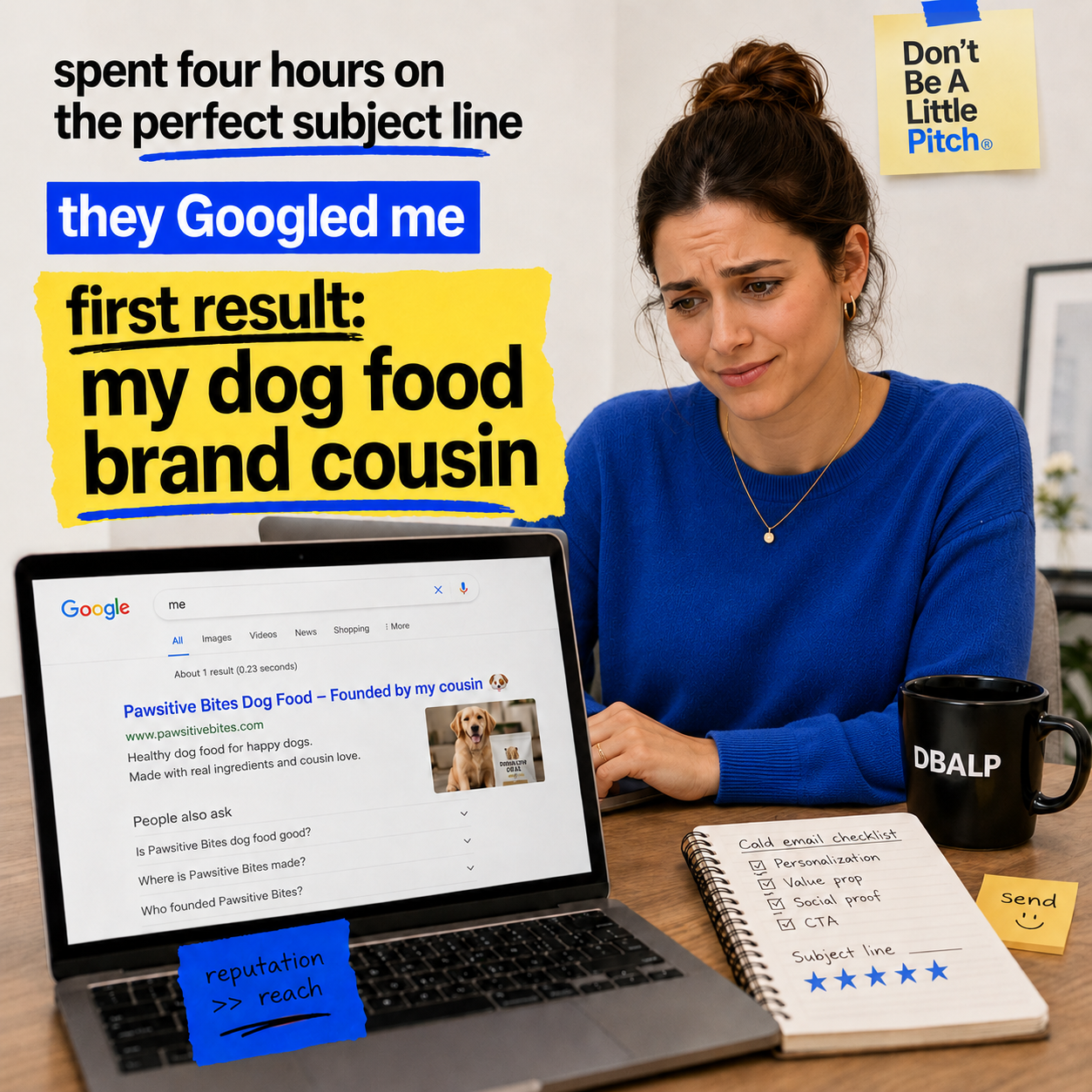
Oh, you sent a perfect cold email? With the headline and the personalized opener and the little joke that wasn't actually that funny but you thought it was charming?
Adorable. Truly. And it didn't matter even a little bit, because the second someone got even mildly interested, they did the one thing every single person does before responding to literally anyone: they Googled you.
This is not a secret. This is not new information. This is just personal branding, the thing you apparently skipped while obsessing over your subject line. Cold email response rates already sit between 1% and 5%, and you're out here torching even that tiny chance because your search results look like a crime scene. Did we think this through, or...?
Why Personal Branding Actually Starts With a Google Search
Here's the part where I explain something you should have figured out on your own. Real personal branding means making sure that when someone searches your name, what they find actually represents you, instead of a "coming soon" page from 2019 or your suspiciously similar-sounding dog food brand cousin.
Wait. You thought a great pitch alone would close this? Be so serious right now.
Before someone replies to your pitch, hires you, partners with you, or hands you literally any amount of money, they're going to Google yourself for them, basically, whether you've done it on purpose or not. This is not paranoid behavior on their part. This is just how trust works now. Your bold pitch means absolutely nothing if your search results whisper back "who dis?"
What should show up within 30 seconds of someone Googling you: your name and what you actually do, ideally said the same way across every platform. Your company or project name. A working website or portfolio. And at least one piece of third-party proof that you're not making this all up: a feature, a quote, a client shoutout, something.
If none of that shows up, your online presence is currently a void, and the void is not closing deals for you. The void has never closed a deal for anyone.
The Three-Minute Self-Audit You're About to Pretend You Don't Need
This is basic. I'm doing it anyway because apparently it needs to be said out loud, to adults, with jobs.
Open a new tab. Google yourself by searching your full name in quotation marks. Not just your name floating around unprotected, the actual quotation marks, so you get exact matches instead of every other person who shares your name and their questionable life choices.
Add context if the results are a mess, which they will be. Try your name plus your city, your name plus your company, your name plus your school. This narrows things down to you specifically and not the 37 other people who apparently also exist and are somehow also a mess.
Now scan for the red flags, and there are always red flags. Nothing recent? You currently look like a ghost who gave up on the internet years ago. Brand confusion, where someone else owns your name online? Deeply unfortunate and extremely fixable, but mostly just deeply unfortunate that you let it happen. Old photos paired with an ancient bio? It reads like you peaked in college and decided that was enough effort for one lifetime.
Bonus round: Google your email address too. The things that surface on random forums and outdated directories will make you want to lie down. I'm actually embarrassed for you, in advance, before you've even done it. Knowing how to clean up your reputation when it gets ugly starts with knowing exactly what's already out there, which apparently most of you have never bothered to check.
How to Fix Your Personal Branding When the Audit Goes Badly
If your audit came back looking rough, don't panic, mostly because panicking won't fix it and also because I'm not surprised. Start with the three profiles that carry the most weight with both humans and algorithms, because apparently nobody told you those are not the same thing as your Finsta.
Your LinkedIn is usually the first result Google serves up, so fix your headline to actually say what you do instead of something vague and inspirational. "Visionary." Be so serious right now. Clean up your URL so it reads as your actual name and not some leftover handle from 2014. Update your photo and banner so they look like they belong to a person currently alive in this decade.
Your website or About page, whatever form it takes, needs to clearly say what you do, who you help, and how to reach you. This is genuinely not complicated and yet, here we are, having this conversation.
Your Google Business listing or Google account bio matters more than you think, because it's searchable even if you're not running a business. This is your flag planted in the ground saying "I exist and I am, in fact, a real professional," which apparently needs to be said out loud now too.
And here's the part most of you are guaranteed to be failing: consistency. Building personal branding that doesn't confuse everyone who looks you up means your LinkedIn, your website, and your bio all need to say the same thing about who you are. If LinkedIn says "marketing specialist," your website says "branding consultant," and your old Twitter bio still says "college student," you have personally confused both the algorithm and every human who has ever looked you up. This is basic. This is so basic.
The Numbers, Since Apparently You Need Them Spelled Out
I'm about to ruin your week slightly, but you'll thank me, eventually, possibly never.
75% of employers Google a candidate's name before hiring them. 42% of adults research someone online before deciding whether to work with them at all. Did we think this through, or did we just assume our charm would carry through a search engine that has no idea what charm is? This is not a hypothetical scenario you can avoid by being delightful in person. It is happening constantly, silently, before you're even in the room, while you are still congratulating yourself on that subject line.
A 2024 Jobvite study found that 55% of recruiters have reconsidered a candidate based on what showed up in their social search, and the majority of those reconsiderations went the wrong direction. Meaning: your online presence is actively costing you opportunities you never even knew you lost. That's the part that should keep you up tonight, not your subject line. Your subject line was never the problem. I'm sorry someone has to be the one to tell you.
Consistency isn't just a nice-to-have either, shocking absolutely no one who is currently reading this with their stomach slightly sinking. A 2025 Statista study found that brands with consistently presented information across platforms are three to four times more likely to achieve real visibility. And this applies to search engines and the AI tools now pulling from the same indexed, structured information.
If your personal branding isn't consistent, you're confusing every system designed to recommend you, which is an impressively efficient way to sabotage yourself without even trying.
Fine, Borrow Some Credibility, You Clearly Have None Yet
You don't need a Forbes feature to start fixing this. Calm down. You just need someone, anyone, who isn't you, vouching for the fact that you're real and competent, because apparently your own word isn't doing the job.
Reply to a reporter request through a service like Connectively with a short, genuinely useful quote in your area. Did we think this through, or did we just assume credibility shows up on its own? It does not. Offer fifteen minutes of insight to a niche podcast or newsletter that actually reaches your audience. These are small moves. They compound, which is more than I can say for whatever you've currently been doing.
Keep It Current, Because the Internet Does Not Forgive, Ever
Your personal SEO isn't a one-time fix you complete and then ignore forever like a gym membership you bought in January and abandoned by February. It needs regular maintenance or it gets crusty fast, and "crusty" is generous.
Do a self-audit periodically. Set a Google Alert for your name so you actually know when new mentions appear instead of finding out the hard way, in the middle of an important meeting, while everyone watches your face change.
Go Google Yourself. We'll Wait. We Have Time.
If what comes up makes you wince even slightly, that's useful information, not a personal attack, though I understand the confusion given how this has clearly gone for you so far.
Now you know exactly what to fix. Don't Be A Little Pitch helps brands and founders turn an embarrassing search result into a personal branding asset that actually works for them, which, statistically, is more than you've managed on your own.
FAQ
Why does personal branding start with Googling yourself?
Because whatever shows up when someone searches your name is the first impression they form before you ever get to make your case, and no, your case does not get to override what they already saw. Personal branding that ignores your actual search results is just decoration on a building nobody can find the entrance to.
Do employers and clients actually Google people before hiring or working with them?
Yes. Constantly. Obviously. The majority of employers search a candidate's name before making a hiring decision, and a significant share of consumers research someone online before deciding to work with them. This applies to freelancers, founders, and job candidates alike, and yes, that includes you specifically.
How do I know what shows up when someone Googles me?
Search your full name in quotation marks in an incognito browser window so you don't get personalized results that flatter you into a false sense of security. Add context like your city, company, or school if there are multiple people with your name. Check the first page closely for outdated information, brand confusion, or anything that doesn't represent your current work, because something always does.
How long does it take to fix a bad online presence?
A basic audit takes about three minutes, which is less time than you spent agonizing over your last subject line. Fixing the highest-impact profiles, your LinkedIn, your website or About page, and your Google Business or account bio, can be done within an afternoon. Building third-party credibility takes longer but compounds quickly once it starts, assuming you actually start.
What's the most common mistake people make with their personal branding?
Inconsistency, and it is not close. When your LinkedIn, website, and other profiles describe you differently, it confuses both the people searching for you and the search engines trying to index and recommend you. Keeping your name, title, and description consistent across every platform is one of the simplest and most overlooked fixes, which is exactly why it's still a problem.

60-Day Performance Guarantee
PR only works if it builds momentum fast. If we do not secure 2 meaningful earned media features and line up 3 additional opportunities within 60 days, you get a full refund.

Free Authority Score Checker
Check your online reputation and authority score for free and see how you stack up and get custom tips to improve instantly.




.png)