Influencer Marketing Has a Freeloader Problem, and Small Businesses Are Paying For It

TLDR:
- Influencer marketing was supposed to mean strategic partnerships. Somewhere along the way it turned into a free-for-all
- Bridal parties, group chats, and random accounts now DM small businesses like they're entitled to free inventory
- Real PR packages go to people whose audience actually overlaps with yours. Everything else is just spam wearing a nice font
- You don't owe anyone a freebie because they asked nicely, or at all
- Saying no is not rude. It's the whole business model working correctly
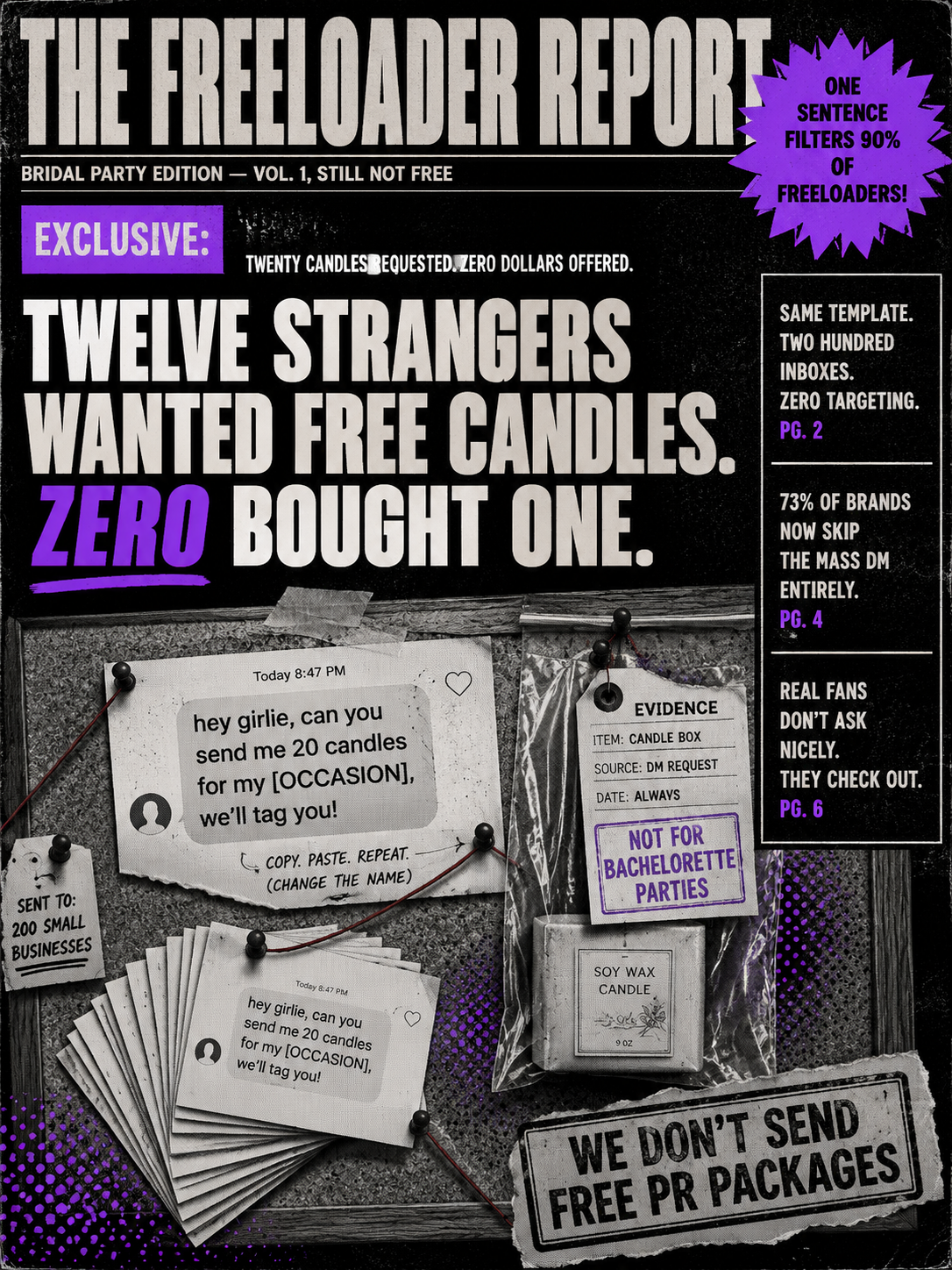
Let me paint you a picture, because apparently it needs painting. You run a small candle business. You pour, label, and ship every single order yourself.
One morning your inbox is full of messages that all read suspiciously the same: "hey girlie, can you send me 20 candles for my bachelorette, we'll tag you!" Translation, and I do mean translation because nobody's saying the quiet part: work for free so a group of mildly drunk bridesmaids might, maybe, post your logo for six hours before it disappears into the void.
Welcome to modern influencer marketing, bachelorette division. It is not what it used to be, and somebody should say that plainly instead of pretending this is all still a healthy ecosystem.
Influencer Marketing Was Never Supposed to Mean Free-for-All
Here's what they meant to say the first time this trend started: "we'd love to feature your product to an audience that actually cares about it." Here's what it turned into: every bridal party in America apparently decided they're a marketing team now, sliding into DMs with copy-paste pitches demanding free goods like a small business is Party City with better branding.
Influencer gifting was originally a targeting tool, not a birthright. You pick a creator whose audience genuinely overlaps with yours, you agree on terms, and both sides actually get something. That's not a nice-to-have, that's the entire mechanism.
Brands still doing this correctly know it. Roughly 73 percent of brands favor working with micro creators specifically because their engagement sits in a real, usable 2 to 8 percent range, according to PR package research from SponsorRadar, which is a completely different universe from a mass DM sent to two hundred accounts with zero targeting whatsoever.
The TikTok Bride DM Spam Nobody Asked to Be Part Of
I need someone to explain to me, calmly, at what point "influencer" became a costume anyone can wear for the length of one bachelorette weekend. There's no targeting. No audience overlap. No effort beyond a copy-paste template with your business name swapped in.
Just an assumption that a free product is somehow owed because a request was made with enough exclamation points.
For small business owners already juggling supply chains, shipping delays, and customer service at midnight, this is not flattering. It's exhausting. And it burns people out fast, because every unpaid request still takes real time to read, evaluate, and respond to, even the ones that get deleted on sight.
What Real PR Packages Actually Look Like (Let Me Translate)
Let me translate this for you, since apparently it's not obvious: PR packages that actually work are boring, in the best way. They're specific.
Brands running successful gifting programs look at engagement and audience fit before follower count, not after. 69 percent of brands now prioritize working with smaller creators specifically because of that engagement signal, according to gifting research from InfluencerGiftForm, and the ones that get it right treat a free product like a genuine test of fit, not a giveaway.
That's a very different universe from a random bachelorette group chat of twelve strangers who will never think about your brand again after the wedding. Not a hot take. Just math nobody wants to say out loud because it makes the mass-DM strategy look as lazy as it actually is.
If you've ever wondered whether the coverage or tags you did get were actually worth anything, this breakdown on knowing if your PR efforts are working is a good gut check before you send a free product to the next person who asks nicely.
How to Say No to Free PR Requests Without Losing Your Mind
You are allowed to have a policy. Post it on your site. "We don't send free PR packages. Here's our actual collab form." That single sentence filters out roughly ninety percent of the copy-paste requests before they ever reach a real inbox.
Build a tiered response instead of treating every DM the same. A creator with a genuinely aligned audience gets a real conversation. A copy-paste bride gets a discount code and a polite redirect. If someone truly loves the brand, they'll pay for it, even at a reduced rate, because actual fans buy things instead of asking for them.
Protect your time like it costs money, because it does. You don't owe anyone a freebie just because they asked. Not once, not twice, not with a "we'll tag you" attached like that's collateral.
Are Micro Influencers Worth the Investment for Small Business
Sometimes, yes, when it's targeted. Micro influencers remain one of the cheapest ways to test whether a creator genuinely likes a product before paying anyone, according to gifting economics research from Influencer Advisory, which found that even small creators typically start commanding real paid rates once a relationship proves itself. The keyword there is relationship, not request.
If your business is still deciding whether visibility actually matters more than the specific value it's supposed to build, this piece on brand awareness without a point of view covers exactly why exposure alone was never the goal in the first place.
The Bottom Line on Influencer Marketing, Since Nobody Else Will Say It
Saying no is a flex, not a failure. Every freebie you don't send is inventory you didn't lose, energy you didn't burn, and brand value you didn't hand over to someone who was never going to convert it into anything real.
The next bridal group chat that slides into your DMs is not owed a box. They're owed a link to checkout, same as everyone else.
Don't Be A Little Pitch exists because most small businesses can spot the difference between a real opportunity and a freebie hunter, they just need permission to say no out loud. Consider this permission.
FAQ
What is influencer marketing gifting?
Influencer marketing gifting is when a business sends a free product to a creator in exchange for content, exposure, or a review, typically as a lower-cost alternative to a paid partnership.
Is it normal for influencers to ask small businesses for free products?
Requests happen often, but a legitimate request usually comes from someone whose audience genuinely overlaps with the brand's, with clear terms attached. Mass, copy-paste requests with no audience fit are not standard practice, they're spam.
How do I say no to an influencer asking for a free product?
A clear, public policy works best. State plainly that free packages aren't offered, and redirect to a collab form, wholesale option, or discount code instead.
Are micro influencers worth it for a small business?
Yes, when they're targeted toward creators whose audience actually matches the business's customers. Untargeted mass gifting rarely produces a measurable return.
How can I tell if a collaboration request is a legitimate opportunity?
Look for audience overlap, clear terms, and specificity in the request itself. Generic, copy-paste messages with no targeting are a strong signal to decline.

60-Day Performance Guarantee
PR only works if it builds momentum fast. If we do not secure 2 meaningful earned media features and line up 3 additional opportunities within 60 days, you get a full refund.

Free Authority Score Checker
Check your online reputation and authority score for free and see how you stack up and get custom tips to improve instantly.




.png)