Brand Storytelling Lessons From a Dragons' Den Deal-Maker

TLDR:
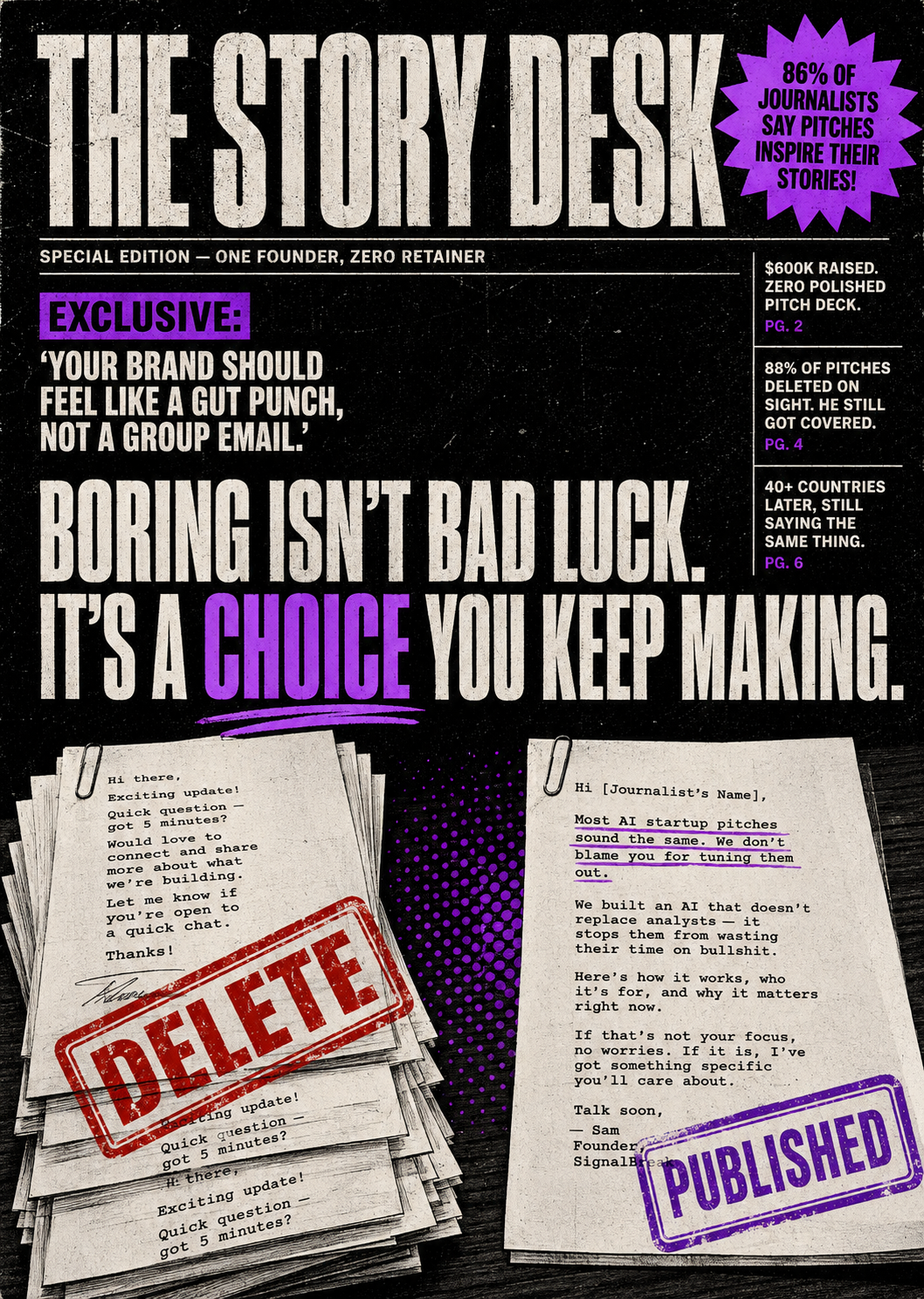
- Your brand storytelling isn't unlucky. It's just boring, and boring is a choice you keep making.
- Bryce North raised $600K in crowdfunding, scaled into 40-plus countries, and closed on Dragons' Den. None of that happened because his product was better than everyone else's.
- 88% of journalists delete a pitch the second it misses their beat. Your PR strategy is competing with a delete key, not with other brands.
- Media coverage doesn't go to the best product. It goes to the clearest story. Those are different things and you keep confusing them.
- A founder brand with an actual opinion outperforms a company with a press release. Every single time.
So you built the thing. You're proud of the thing. You have a deck about the thing. And somehow the media keeps behaving like the thing doesn't exist.
Shocking.
Here's the part you didn't want to hear: your brand storytelling is the problem, and it has been the whole time. Not your budget. Not the algorithm. Not the fact that journalists are "gatekeepers." The story. The one you've been telling in the same flat voice at every networking event since you started.
Bryce North, founder of Don't Be A Little Pitch, went on Business Owners Tell All: What It Takes with host Jamie Seeker and said a handful of things that people apparently need repeated slowly. Broadcasting out of Manila, running globally, $600K raised through crowdfunding, scaled across 40-plus countries, and a deal closed on Dragons' Den. Not because the product was revolutionary. Because the story landed. The uncomfortable version of that story is here, if you want the receipts.
Let's go through what he said, since apparently it needs subtitles.
"If You're Not Telling Your Story, Someone Else Is"
Full quote: "If you're not telling your story, someone else is... and they probably won't get it right."
Cool. So the silence you've chosen isn't neutral. That's the part people miss.
Every category has a default narrative, and when you don't supply one, you get assigned the generic one. You become "another agency." "Another app." "One of those." A competitor's positioning becomes the frame everybody reads you through, and you didn't even get a vote.
The trust research makes this worse for you, not better. The Edelman Trust Barometer, based on roughly 34,000 respondents across 28 countries, found seven in ten people are unwilling or hesitant to trust someone whose values, background, or information sources differ from their own. Nobody's extending you the benefit of the doubt. If you haven't defined yourself, someone else's shortcut becomes your reputation.
Brand storytelling isn't a marketing luxury. It's damage control you're currently not doing.
Your Brand Storytelling Should Feel Like a Gut Punch, Not a Group Email
Full quote: "Your brand should feel like a gut punch... that's how you know it's working."
Be honest. When was the last time anyone reacted to your messaging? Not "engaged." Reacted. Flinched. Forwarded it to someone with no context.
If the answer is never, you're invisible, and invisible isn't safe. It's just a quiet failure with better branding.
Look at the name Don't Be A Little Pitch. It's not clever for the sake of cleverness. It does actual work: it repels the corporate clients who'd hate working that way and attracts the ones who want someone with a spine. That's a filter, and filters are the most underrated part of a PR strategy. Most brands optimize to offend nobody and end up memorable to nobody, which is a strange goal to spend money on.
Being bold isn't a risk. Forgettable is the risk. You've just never priced it that way.
The Media Doesn't Care About Your Product, They Care About Your Why
Full quote: "The media doesn't care about your product... they care about your why."
This one should be embarrassing to have to explain, and yet.
A journalist's job isn't to promote you. It's to be useful to their readers. Your feature list isn't useful to their readers. The reason the feature exists might be.
The math is brutal. Cision's State of the Media research, which surveyed more than 3,000 journalists, found over half receive 50-plus pitches a week. And per Muck Rack's State of Journalism 2026 report, 88% delete pitches that miss their beat. Not read and decline. Delete.
Then the twist that should make you sit up: 86% of those same journalists say pitches do inspire some of their stories. So it works. It just doesn't work for you, specifically, because you're pitching a product to someone who covers a subject.
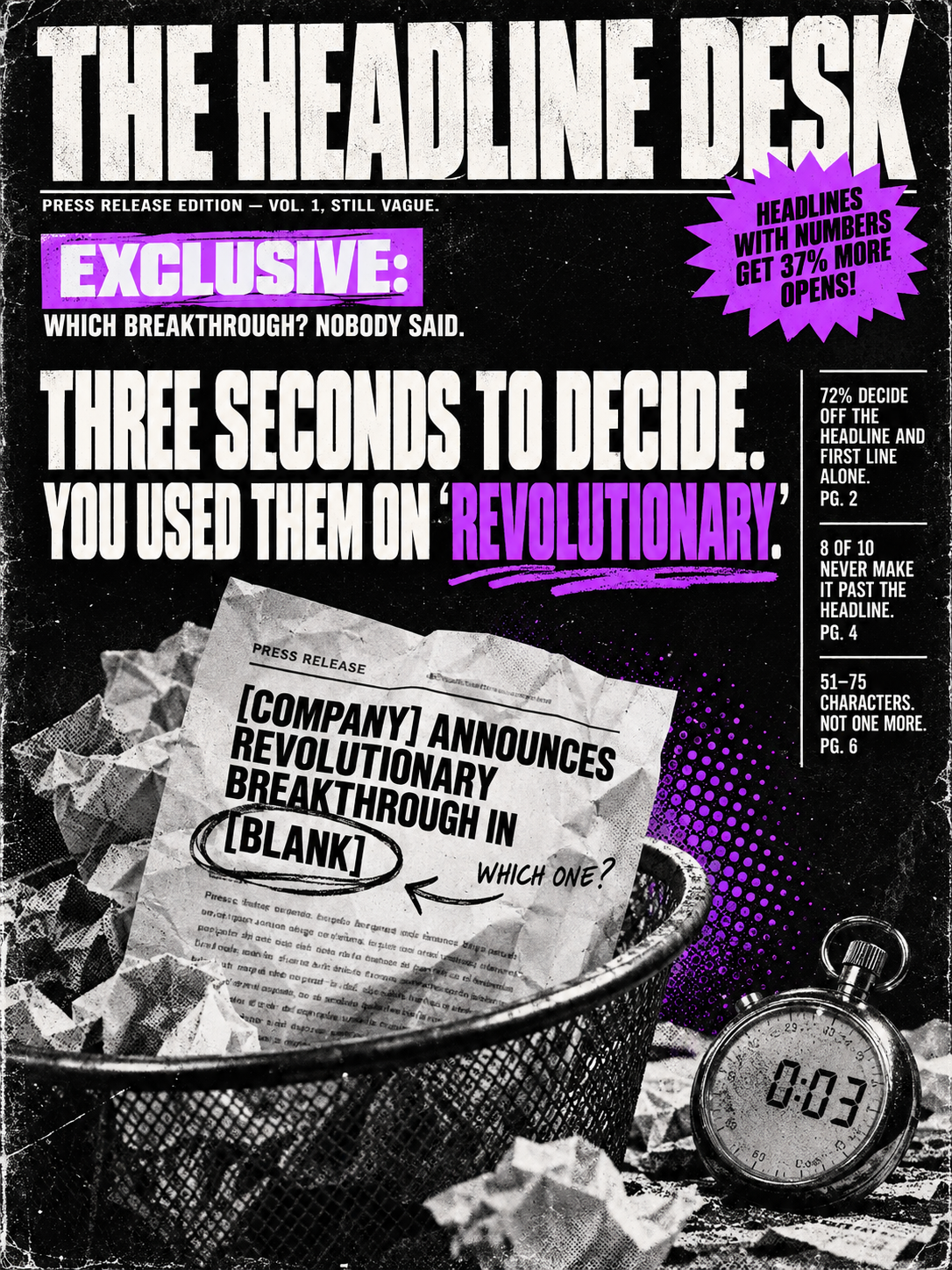
Bryce's filter is blunt and correct: if you can't explain what you do in roughly the length of a tweet, don't pitch it. Muck Rack's data agrees, with journalists preferring short, one-to-one emails. Your three-paragraph opener about your "mission to revolutionize" is not the flex you think it is.
How to Get Media Coverage Without a Budget or an Agency
Everyone wants this to be a money problem. It's so much more comfortable when it's a money problem.
It isn't. Media coverage without a retainer comes down to three unglamorous things:
- Personalized pitches, meaning you actually read the person's work
- Timing that connects to something happening in the world, not something happening in your product roadmap
- Relevance to that specific outlet's audience, not to your quarterly goals
None of that requires an agency. All of it requires you to stop sending the same email to forty people. The founder-brand version of this goes deeper, because a human voice consistently outperforms a company account and always has.
Be Obsessed With the Problem, Not Your Solution
Full quote: "To be a business owner, you've gotta be obsessed with the problem, not just the solution."
This is the one that separates founders who get quoted from founders who get archived.
Solution-obsessed people talk about themselves. Problem-obsessed people talk about the thing everyone's stuck on, which is, conveniently, the thing journalists write about and audiences search for. Your solution is one answer. The problem is the whole conversation, and you can own that without mentioning your product once.
It compounds, too. Muck Rack's analysis of more than a million cited links found earned media accounts for the overwhelming majority of AI citations, well ahead of brand-owned pages. So the coverage you earn by being useful about a problem keeps working inside AI answers long after the article stops getting traffic. A founder brand built on a problem doesn't expire.
Which brings us to the Dragons' Den thing. That deal wasn't a win. It was a spark. The leverage came from what got built on top of it afterward, and most people would have posted the clip, felt great, and done nothing else.
Fine. Here's the Actual Point About Brand Storytelling
You've been treating it as decoration you'll get once the product's finished. It's not decoration. It's the difference between a company people can describe and a company people can't.
Say something specific. Say it in a way someone could disagree with. Say it consistently enough that a journalist knows what you'd say before they call.
That's it. That's the whole strategy you've been avoiding.
You already have a story. You're just telling it like it's a compliance document. Don't Be A Little Pitch tells it like it's worth hearing.
FAQ
What is brand storytelling in PR?
It's the practice of building a consistent narrative around why your company exists and what problem it's obsessed with, then using that narrative as the basis for media outreach. It replaces product-led pitching with subject-led pitching, which is what journalists actually respond to.
How does brand storytelling help you get media coverage?
It gives a journalist a reason to care that isn't "this company did a thing." Muck Rack's research shows 88% of journalists delete pitches that miss their beat, and a clear story is what proves relevance to their beat before you ask for anything.
Can you get press coverage without hiring a PR agency?
Yes. It takes personalized outreach, a genuine reason the story matters now, and relevance to that outlet's readers. An agency speeds up relationships and sharpens positioning, but it can't invent a point of view you haven't developed.
What makes a good founder brand?
A specific, defensible position on a problem in your industry, communicated consistently in your own voice. Audience size matters less than clarity. A founder known for one sharp opinion gets more inbound than a company known for nothing in particular.
How long should a pitch to a journalist be?
Short. Journalists surveyed by Muck Rack consistently prefer brief, one-to-one emails over long ones, and most report receiving dozens of pitches weekly. If your core idea needs three paragraphs to explain, the idea isn't clear enough yet.
How do I know if my brand storytelling is working?
Watch for inbound quote requests, whether people describe your company back to you accurately, referral traffic from third-party coverage, and whether your brand appears in AI-generated answers about your category. If nobody can repeat your story without your deck open, it isn't working.

60-Day Performance Guarantee
PR only works if it builds momentum fast. If we do not secure 2 meaningful earned media features and line up 3 additional opportunities within 60 days, you get a full refund.

Free Authority Score Checker
Check your online reputation and authority score for free and see how you stack up and get custom tips to improve instantly.




.png)