Being a Digital Nomad Doesn't Make You Interesting, It Makes You a Liability Until Proven Otherwise

TLDR:
- A digital nomad founder with buffering WiFi and a buffering pitch is the same problem twice, and nobody's waiting for either one to load
- Investors aren't funding your lifestyle. They're funding whether you can execute consistently, from anywhere, on command
- Digital nomad founders who actually get taken seriously build systems, not vibes
- Personal brand matters more when you have no office to point to, not less
- Third party media coverage is the fastest way to prove you're not making this up
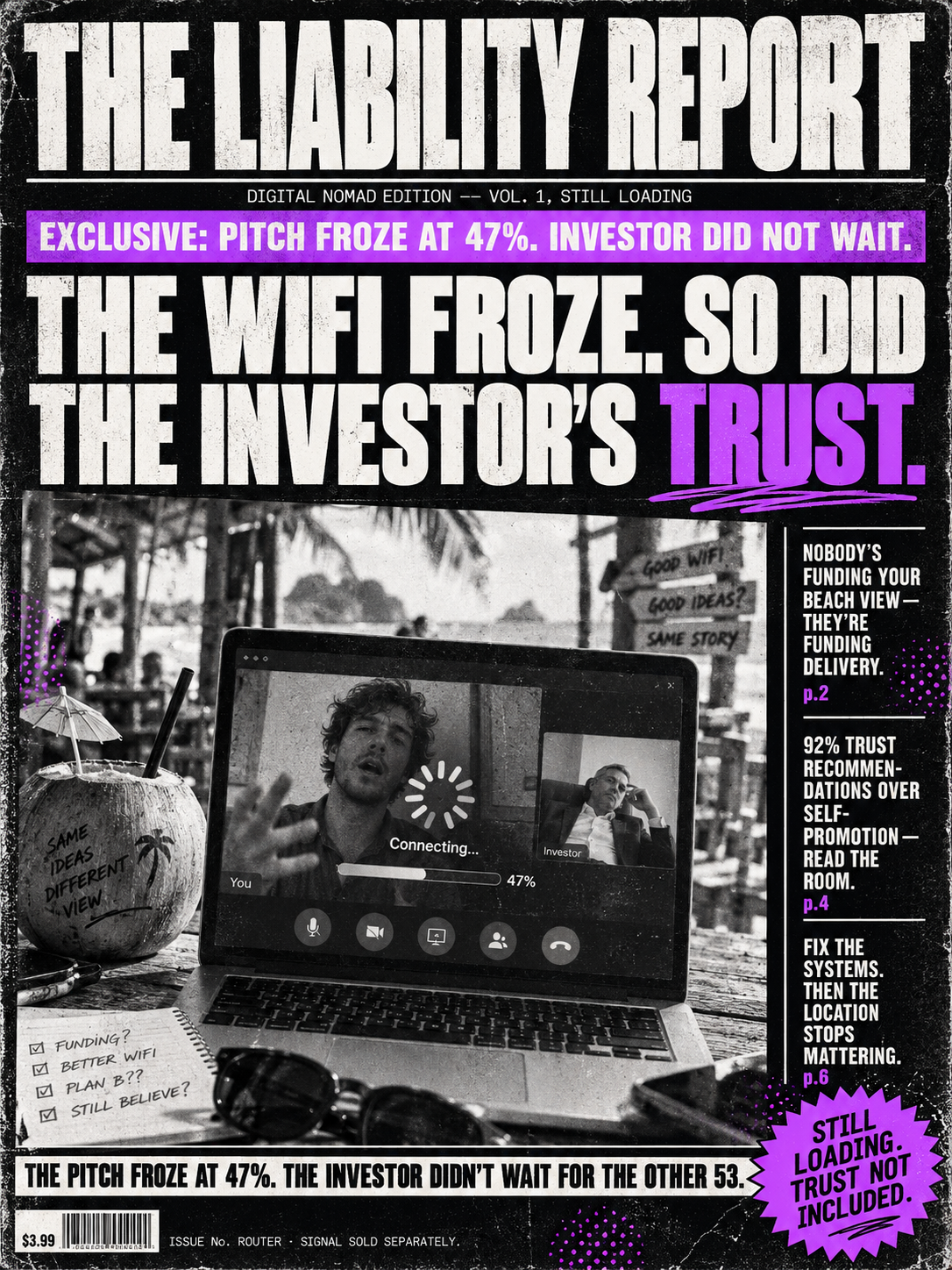
Let me translate something for you, because apparently it needs translating: nobody is impressed by your beachside office. I know. I KNOW. It feels like it should be a flex. It is not a flex. It is a background detail that becomes a liability the second your pitch buffers along with your WiFi and an investor realizes they're about to hand cash to someone whose entire operation depends on a hotel router in Canggu holding steady for one more Zoom call.
Being a digital nomad was never the problem. Treating "I work from anywhere" as a substitute for actual proof of execution, that's the problem, and it's a specific, recurring, extremely fixable one.
Being a Digital Nomad Is Not a Personality, It's a Liability Until You Prove Otherwise
Here's what nobody says out loud in the pitch meeting, so I'll say it: investors and clients are not paying for your vibes. They're paying for the belief that you'll deliver, repeatedly, regardless of time zone, and if your pitch makes them question that even once, they're out. Quietly. Without telling you why.
One founder in this exact position put it plainly: "Failing to separate yourself from your brand. I travel. The business is based where it's based. Regardless of how sexy I want my lifestyle to look, the investors giving you their cold, hard cash expect some predictability." That's Nina Atimah, founder of a skincare startup, and she's not wrong, she's just saying the quiet part that most founders avoid until it costs them a deal.
The scale of this problem, by the way, is not small. The global digital nomad population has climbed past 43 million, and roughly one in five identifies as a startup founder, according to digital nomad workforce research from blog.mean.ceo. That's a lot of founders currently deciding whether "figuring it out" counts as a business model. It does not.
Why Digital Nomad Founders Struggle to Get Investor Trust
Here's the pattern I keep seeing, over and over, like a rerun nobody asked for: digital nomad founders sell the dream and forget the execution. Sunrise yoga content. "Work from anywhere" philosophy. Zero mention of what happens when the client needs a call at 9am their time and it's 3am wherever the founder currently is.
What they meant to say was, "I have systems that make my location irrelevant." What actually got said was a lifestyle brand pretending to be a business plan. Justin Crabbe, CEO of Jettly, nailed the actual difference: "They don't adapt, they design their business systems. They use location independence as a strategic advantage, not a limitation." That's the split. Reacting to your environment versus controlling it. One of those gets funded.
The WiFi Excuse Is Not a Business Strategy
If your schedule is inconsistent, your results will be too, and no amount of charm fixes that math. Freedom without structure isn't freedom, it's just chaos with better lighting. Flexibility that actually works looks boring from the outside, fail-safe connectivity, coordinated time zones, deadlines that get hit regardless of which airport you're currently sitting in.
The remote entrepreneur who fails here isn't unlucky. They're just still treating their business like a travel itinerary and wondering why nobody trusts the itinerary with real money.
If your actual pitch content is the weak link and not your setup, this breakdown of what a real PR pitch hook looks like is worth reading before your next call, WiFi permitting.
Personal Brand Matters More When You Have No Office to Point To
Here's the actual secret weapon, and it's not a better ring light. It's third party validation. A strong personal brand matters more, not less, when you don't have a physical office for people to walk into and judge you by. 92 percent of people trust recommendations from other people over brand messaging, according to personal branding research from DSMN8, and when a journalist tells your story instead of you telling it yourself, that trust transfers in a way your own LinkedIn caption never will.
Media Coverage Is the Only Thing That Actually Builds Trust Remotely
Bryce North, founder of Don't Be A Little Pitch, built exactly this with TrapTap, landing coverage in TechCrunch, Popular Mechanics, Discovery Channel, and CNET. In his words: "That exposure didn't just drive sales, it built trust with customers, attracted investors, and solidified my credibility in the industry." That's media coverage doing the one thing a beach photo never will, proving a third party independently vouches for you.
For a deeper read on whether coverage like that is actually converting into something measurable, this breakdown of how to know if your PR efforts are working covers exactly that gap.
The Bottom Line on Being a Digital Nomad
Your WiFi being unreliable is annoying. Your pitch being unreliable is fatal. Separate the lifestyle from the business, build systems that don't care what city you're in, and invest in a personal brand backed by real media coverage instead of a highlight reel nobody asked to see.
Stop blending in with every other laptop-in-a-cafe founder story. Don't Be A Little Pitch exists because most digital nomad founders can spot a flaky pitch a mile away and somehow don't notice when it's their own.
FAQ
Can you run a credible business as a digital nomad?
Yes, but credibility depends on demonstrated systems and consistency, not location. Investors and clients evaluate reliability and execution, which can be built and proven regardless of where a founder is based.
Why don't investors trust digital nomad founders as easily?
Investors are often concerned about predictability and consistent execution. A founder who emphasizes lifestyle over operational structure can unintentionally raise doubts about their ability to deliver reliably.
How do I build a personal brand while traveling?
Focus on demonstrating expertise and consistency through content, media coverage, and third-party validation rather than lifestyle-focused content, since credibility is built through proof, not location.
Does media coverage actually help build credibility for a remote founder?
Yes. Third-party media coverage functions as independent validation, which tends to build more trust with investors and customers than self-promotional content alone.
What systems do digital nomad entrepreneurs need to be taken seriously?
Reliable communication infrastructure, coordinated scheduling across time zones, and consistent delivery on commitments are the baseline systems that signal professionalism regardless of location.
60-Day Performance Guarantee
PR only works if it builds momentum fast. If we do not secure 2 meaningful earned media features and line up 3 additional opportunities within 60 days, you get a full refund.

Free Authority Score Checker
Check your online reputation and authority score for free and see how you stack up and get custom tips to improve instantly.




.png)