Brand Messaging: Where Bold Ends and Cringe Begins

TLDR:
- Bold and reckless brand messaging look identical in a deck. They stop looking identical once the campaign is live.
- The difference is intent. One amplifies a position. The other manufactures a reaction and calls it a strategy.
- 88% of journalists delete a pitch that misses their beat. Volume has never been the variable.
- Shock earns attention quickly and brand credibility slowly, and only one of those compounds.
- If a PR campaign makes the audience feel seen, it works. If it makes them wince, that was measurable too.
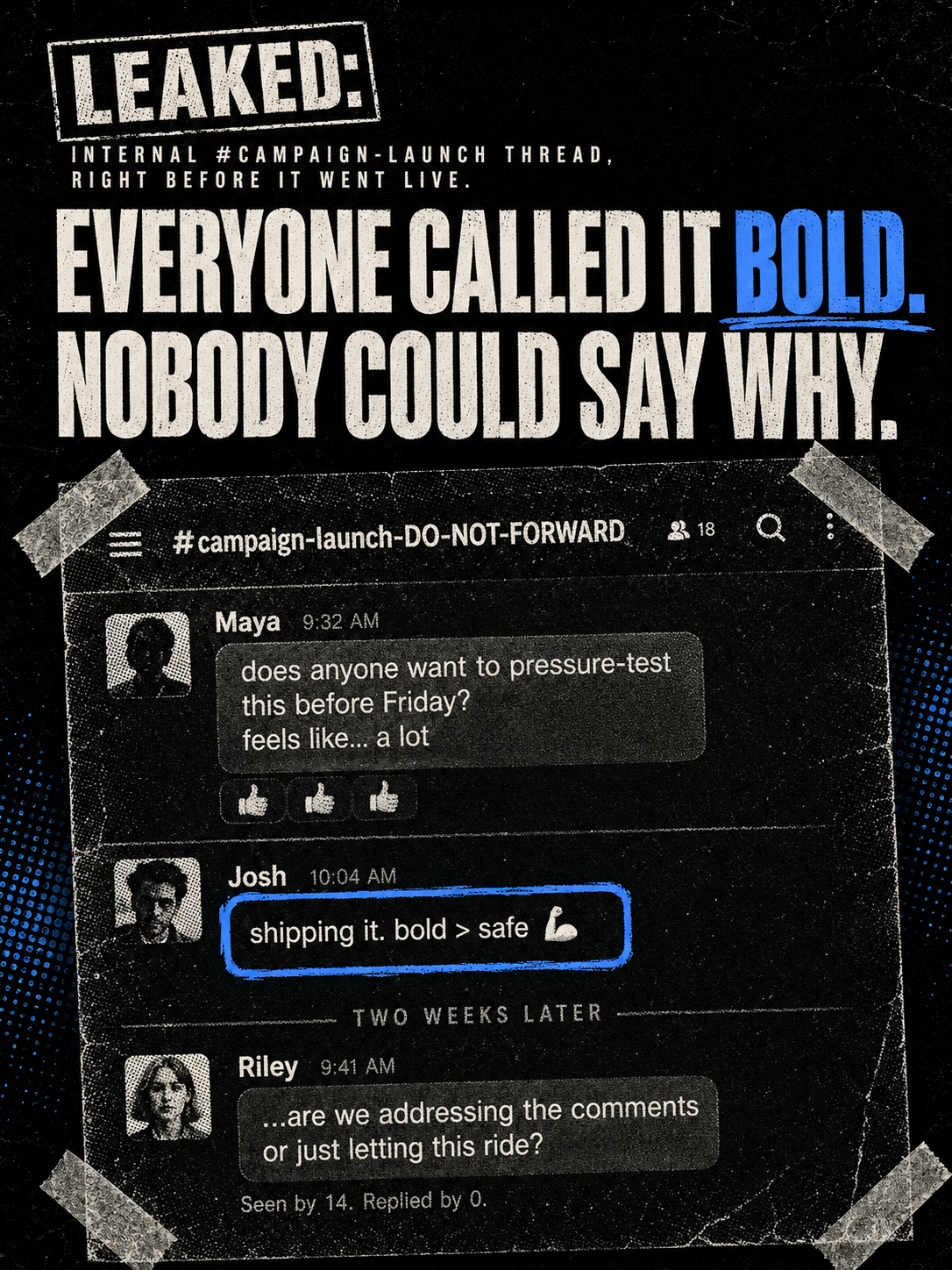
There's a particular kind of meeting where a campaign gets approved because nobody wanted to be the person who said it seemed like a lot.
The room agrees it's bold. Someone uses the word disruptive. The deck has a slide explaining why the risk is worth taking, and that slide is usually very well designed.
What the deck rarely contains is a distinction between a brand messaging decision that says something and one that simply attracts notice. Those are different objectives with different outcomes, and the gap between them tends to become visible only in retrospect, which is an inconvenient time to notice it.
What Makes Brand Messaging Bold Instead of Reckless
Bold isn't a volume setting. It's a position held with enough precision that a reasonable person could disagree with it.
Reckless is what happens when a brand skips the position and goes straight to the reaction. The output can look almost identical. A provocative line, an unexpected format, a claim that makes the legal team ask a follow-up question. The distinction sits underneath, in whether anything is being asserted at all.
Bold says: we're making a statement. Reckless says: we're making noise.
The test is unglamorous. Before anything is published, the question worth asking is whether this amplifies the message or merely attracts attention. The first builds something. The second builds a different kind of something, usually a meeting.
Interestingly, most brands that describe themselves as bold cannot articulate the position they're being bold about. Brand awareness without a point of view covers the quieter version of that same failure.
Why Shock Campaigns Peak Early and Collapse Quickly
Emotion moves messaging. That part is well established and rarely disputed.
What gets skipped is that not every emotion produces the same downstream behavior. Shock generates immediate distribution and very little else. Recognition generates less immediate distribution and considerably more of everything that matters afterward.
The trust environment has made this less forgiving. The Edelman Trust Barometer, drawing on roughly 34,000 respondents across 28 countries, reports that seven in ten people are unwilling or hesitant to trust someone whose values, background, or information sources differ from their own. Audiences are contracting into circles they already trust. A PR campaign built to interrupt a stranger is arriving into a room that has already decided it isn't accepting introductions.
Over-the-top messaging communicates look at us. Bold messaging communicates we understand you. Only one of those survives the week.
The Difference Between Confident and Arrogant Brand Messaging
Confidence and arrogance are frequently confused in strategy documents and almost never confused by audiences.
Confidence speaks from purpose. Arrogance speaks from comparison. The text is grammatical, which makes it easy to audit. We're proud of what we built as a statement about the brand. We're better than everyone else is a statement about everyone else, and it requires the audience to agree with an assessment they weren't invited to make.
A brand can be bold without diminishing anyone. It can stand out without standing on something. Brand reputation is not a volume contest, though the number of companies operating as though it were suggests the message hasn't fully circulated.
It remains unclear whether the teams producing this copy believe it or have simply never had it read back to them. The version of this problem that shows up in brand voice is worth reading, particularly the part about performed authenticity.
Why Bold Messaging Builds Authority While Noise Builds Fatigue
Virality resolves. Authority accumulates. These operate on different timelines and reward different behavior, which is why campaigns optimized for one tend to underperform on the other.
The loudest PR campaign in a category is rarely the most effective. It's frequently the most forgettable, because volume without a position gives the audience nothing to retain.
There's a practical dimension to this that has become harder to ignore. Cision's State of the Media research, surveying more than 3,000 journalists, found over half receive 50-plus pitches weekly. Muck Rack's State of Journalism 2026 report adds the relevant number: 88% delete pitches that miss their beat. Louder doesn't clear that filter. Relevant does.
The compounding argument is stronger still. Muck Rack's analysis of more than a million cited links found earned media accounts for the overwhelming majority of AI citations, well ahead of brand-owned pages. Coverage earned by having a defensible position keeps producing visibility inside AI-generated answers long after the campaign concludes. A shock campaign produces a spike and an archive.
How to Tell If Your Brand Messaging Is Bold or Just Loud
The diagnostic is short, which is the only merciful thing about it.
- Can someone state your position back to you without the deck open? If not, the brand messaging hasn't landed regardless of reach.
- Does the campaign work if the provocative element is removed? If nothing remains, the provocation was the entire idea.
- Would a competitor be mildly irritated by it? Mild irritation is usually evidence of a real position. Universal approval usually isn't.
- Is the brand credibility higher after this than before it? Attention and credibility move independently, and only one appears on a balance sheet eventually.
- Would this still make sense once the reference it depends on is forgotten?
Bold brand messaging earns brand credibility by saying something that matters. Over-the-top messaging spends it trying to be noticed. The volume was never the problem. The vision was.
For anyone still convinced that restraint is the safer option, boring brands get ignored makes the opposite case fairly persuasively.
Most brands don't need to be louder. They need to be clearer about what they're actually saying. Don't Be A Little Pitch handles the second part.
FAQ
What is bold brand messaging?
It communicates a clear, specific position that a reasonable person could disagree with. It differs from provocative messaging, which prioritizes reaction over substance. The distinguishing factor is whether an actual claim is being made or simply an attention-seeking gesture.
How do I make my brand messaging stand out without being cringe?
Establish the position before deciding how forcefully to express it. Most messaging reads as cringe not because it's too honest but because it performs a personality the brand hasn't defined. Clarity first, volume second.
What's the difference between confident and arrogant brand messaging?
Confidence makes claims about your own brand. Arrogance makes claims about everyone else. The first invites agreement, the second demands it, and audiences generally notice the difference before the marketing team does.
Why do shock marketing campaigns fail?
They generate rapid attention that doesn't convert into trust. Shock produces distribution and little retention, and in a low-trust environment it frequently produces backlash instead. Campaigns built on recognition rather than provocation tend to outperform over any meaningful timeframe.
How do I know if my brand messaging is working?
Check whether people can restate your position accurately without prompting, whether coverage continues referencing you after the campaign ends, and whether your brand appears in AI-generated answers about your category. Impressions measure exposure, not comprehension.
Is bold brand messaging risky for brand reputation?
Holding a clear position carries some risk. Holding none carries more, because brands without a defined stance are the easiest to ignore and the hardest to defend. The genuine reputational danger sits in provocation without substance, not in having a point of view.

60-Day Performance Guarantee
PR only works if it builds momentum fast. If we do not secure 2 meaningful earned media features and line up 3 additional opportunities within 60 days, you get a full refund.

Free Authority Score Checker
Check your online reputation and authority score for free and see how you stack up and get custom tips to improve instantly.




.png)