AI Search Optimization: The Bing Secret Most Brands Have No Idea About

TLDR:
- ChatGPT pulls 87% of its citations from Bing's search index. Your Google rankings mean nothing here.
- Gemini pulls from Google. Different AI, different search engine, different optimization strategy.
- If your site isn't indexed in Bing, ChatGPT literally cannot recommend you. Full stop.
- "Creative Storyteller" is not a job title AI search optimization can do anything with. Get literal.
- Most brands are doing SEO for one search engine and wondering why three AI tools have never heard of them.
Something is happening right now in every potential client's search session and your brand is almost certainly absent from it.
They type a prompt into ChatGPT. Something like "best PR agencies for founder-led brands" or "top communications firms for startup executives." ChatGPT runs a search, synthesizes the top results, and names a handful of brands in its answer. AI search optimization determines whose name shows up. And the mechanism behind it is almost nobody's SEO strategy.
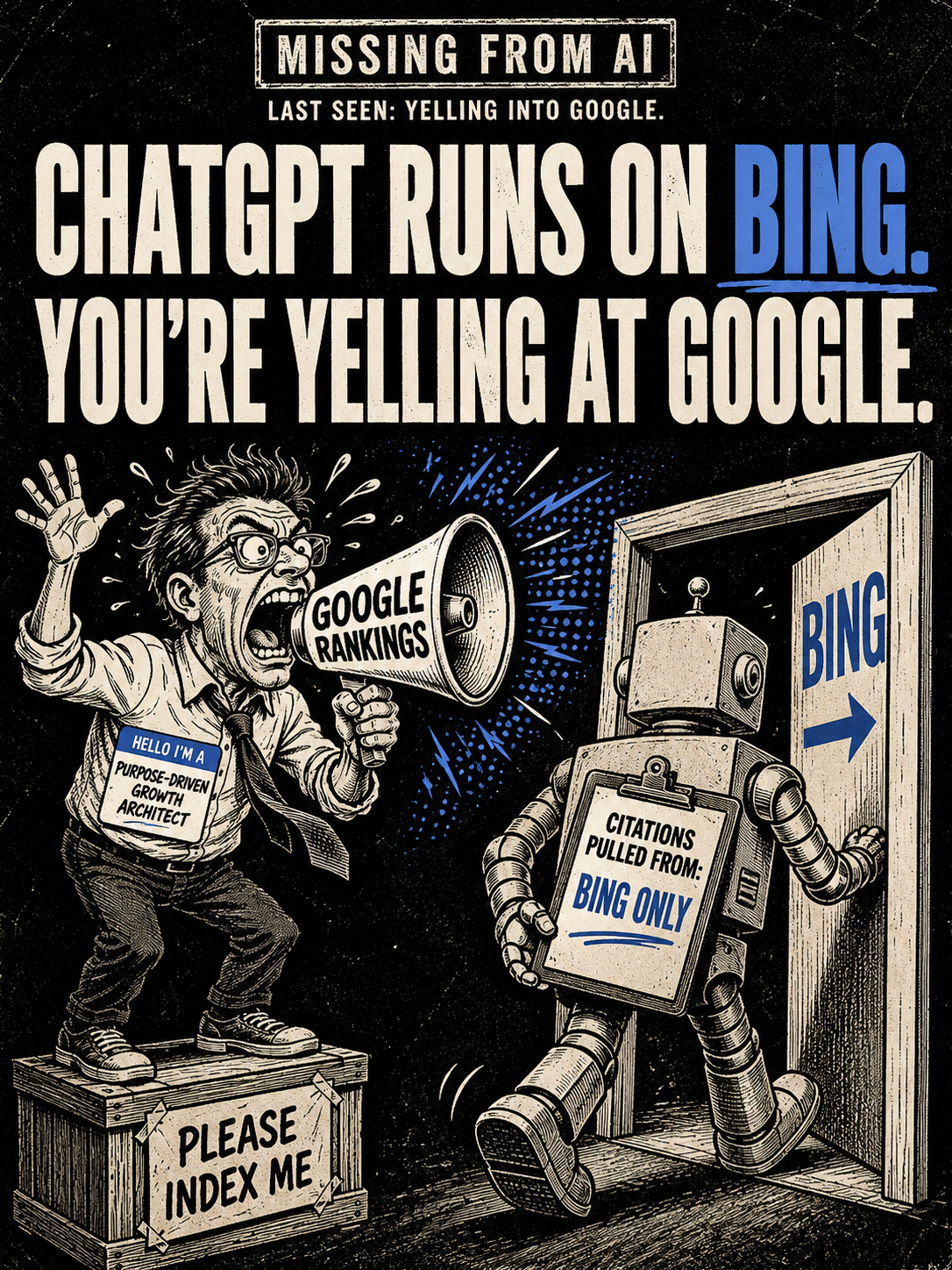
Here's the part the industry has been spectacularly slow to explain clearly: 87% of ChatGPT Search citations come directly from Bing's search index. Not Google. Bing. Your Google rankings have zero direct impact on whether ChatGPT recommends you. Every page you want ChatGPT to cite needs to be indexed in Bing, ranking reasonably in Bing, and structured so ChatGPT can actually extract and use it.
Most brands have never logged into Bing Webmaster Tools in their lives.
Let me translate this for you: the AI recommendation layer that is increasingly where buyers start their research is running on an index that most marketing teams treat as a joke. And the brands that figured this out quietly are showing up everywhere.
Why Your Bing SEO Determines What ChatGPT Recommends
This is the uncomfortable part.
You might have excellent content. Well-written blogs, a polished website, thoughtful LinkedIn posts. And ChatGPT still won't recommend you because Bing hasn't indexed your pages. If your site isn't in Bing's index, it won't appear in ChatGPT's results. Period. The content quality is irrelevant if Bing has never crawled the page.
ChatGPT Search works like this: a user asks a question, ChatGPT runs something called "query fanning" it converts the long question into multiple search queries, sends those to Bing, scans the top 20 to 30 results, and assembles an answer from what it finds most credible and structured. It doesn't check Google. It doesn't check your Instagram. It goes to Bing, and it looks for pages with clear structure, specific language, verifiable information, and some level of existing authority.
What they meant to say in every brand strategy deck about digital presence: "We have a strong Google footprint." What that actually means for AI visibility in ChatGPT: almost nothing.
The fix starts with Bing Webmaster Tools. Submit your sitemap. Verify site ownership. Check which pages are indexed. Compare what Bing has crawled against what actually drives your traffic. This takes an afternoon and most brands haven't done it once.
How Bing SEO and Google SEO Work Differently for AI Search Optimization
Here is where it gets more interesting.
While ChatGPT runs on Bing's index, Google's Gemini pulls from Google's own index and data signals. Which means AI search optimization for ChatGPT and for Gemini require different approaches because they're running on different search architectures.
For ChatGPT: Bing indexing, Bing Webmaster Tools verification, exact-match keywords in title tags (Bing weights these more heavily than Google does), structured content, and consistent brand mentions across public-facing sources that Bing crawls and trusts.
For Gemini: Your Google presence, Google Business Profile, strong Google indexing, content that performs in Google's E-E-A-T framework, third-party mentions in sources Google considers authoritative.
For both: Earned media coverage that gets indexed on both search engines. Publications that rank in both Google and Bing. Bylined articles with your name, title, and specific expertise attached to them in a format both search engines can crawl and assign credibility to.
Most brands are optimizing for one and ignoring the other entirely.
Why Vague Brand Language Kills Your AI Visibility
I need to say something about the language problem because it is quietly destroying brand visibility in every AI-generated recommendation.
AI tools don't interpret identity labels. They match specific literal language to specific search queries. When someone asks ChatGPT for "PR strategists specializing in earned media for tech founders," the tools that get cited are the ones whose content explicitly contains those words, in a readable format, in a page that Bing (or Google, for Gemini) has indexed and trusts.
"Creative Storyteller" invisible. "Brand Disruptor" invisible. "Purpose-Driven Growth Architect" I'm actually embarrassed for you.
"PR Strategist for founder-led brands seeking earned media coverage in business publications" citable. Specific. Matchable.
What they meant to say with all the identity language: "We want to seem interesting and differentiated." What AI reads: insufficient signal. Skipping.
The fix here is specific: audit every crawlable surface your brand has and ask whether the language on it matches what a potential client would actually type into an AI tool. Your website. Your LinkedIn. Your published bylines. Your author bios on guest posts. If the language there doesn't match the queries you want to appear in, AI search optimization hasn't started yet.
Your Googleability and now your Bing-ability matters more than you probably realized, and both start with specific, literal language in indexed formats.
How to Fix Your Bing SEO and AI Search Optimization in One Pass
Here is what AI visibility actually requires. None of it is glamorous. All of it compounds.
Submit to Bing Webmaster Tools and verify your site. Check which pages are indexed. Address the gaps before your competitor does.
Use exact-match keywords in your title tags for Bing. Bing's algorithm still rewards this more directly than Google's semantic matching. The page you want ChatGPT to cite should have your target phrase in the title, H1, and first paragraph.
Build content on crawlable platforms, websites, blogs, LinkedIn Articles, Medium posts, published bylines in real outlets. Social media posts are largely opaque to both Bing and Google's crawlers. A viral post doesn't build AI search optimization presence.
Get indexed in third-party sources both search engines trust. Review platforms, industry directories, media coverage in publications with real domain authority. According to the GEO research out of Princeton and Georgia Tech, content with statistics improved AI citation rates by 32%, citations from credible sources improved visibility by 30%, and quotations from attributed real humans improved it by 41%. AI systematically favors third-party sources over brand-owned promotional copy.
Use specific, literal language everywhere. Your name, your exact title, your precise area of expertise, your company name. All of it is consistent across every surface both search engines crawl.
Think in terms of both indexes simultaneously. The question to ask for every piece of content you publish: is this going to be indexed in Bing AND Google? If it only lives on a social platform, the answer is probably no.
This is basic. The brands showing up in AI-generated recommendations right now aren't doing something exotic. They're doing SEO on both relevant indexes with specific language. That's it.
Brand Visibility in AI Search Starts Here
Potential clients are increasingly starting their brand research with a prompt, not a search bar. And the answer that comes back from ChatGPT or Gemini is shaping their shortlist before any sales conversation happens.
Don't Be A Little Pitch builds brand visibility strategies that account for how AI tools actually surface recommendations earned media that gets indexed in the right places, positioning specific enough to show up when the right prompt gets typed, and the kind of structured content presence that both Bing and Google can use.
FAQ
Why does ChatGPT use Bing instead of Google?
OpenAI and Microsoft have a deep partnership that gives ChatGPT access to Bing's search infrastructure. Building and maintaining a separate search index would be enormously expensive. ChatGPT runs its search queries through Bing's index when web search is active, and 87% of its citations match Bing's top results. Your Google rankings have no direct influence on this.
Do I need a Bing business profile to show up in ChatGPT?
A Bing Places profile doesn't feed directly into ChatGPT's responses, but it helps your website rank better in Bing's organic results, which is what ChatGPT actually pulls from. Verifying your site in Bing Webmaster Tools and submitting your sitemap matters more directly for AI search optimization than the business profile itself.
How is Gemini different from ChatGPT in terms of SEO?
ChatGPT runs on Bing's index. Gemini runs on Google's index. Optimizing for ChatGPT visibility means your Bing presence needs to be strong: indexed pages, exact-match keywords, Bing Webmaster Tools verification. Optimizing for Gemini means your Google presence, Google Business Profile, and E-E-A-T signals need to be strong. The underlying AI visibility strategy requires thinking about both.
Will my social media posts help me show up in AI recommendations?
Social media platforms are largely opaque to both Bing and Google's crawlers. Posts don't get indexed in a way that feeds AI recommendations reliably. What does work: blog posts, LinkedIn Articles, bylined pieces in publications with domain authority, and website content with clear structure. The content needs to live somewhere both search engines can actually read.
What's the most important thing to fix first for AI search optimization?
Check whether your key pages are indexed in Bing. Go to Bing Webmaster Tools, verify your site, submit your sitemap, and look at what's actually in the index. Most brands haven't done this and it's where the AI search optimization gap usually starts. After that, audit your language. If your website, bios, and bylines don't describe what you do in specific, literal terms that match real search queries, AI has nothing credible to match you to.

60-Day Performance Guarantee
PR only works if it builds momentum fast. If we do not secure 2 meaningful earned media features and line up 3 additional opportunities within 60 days, you get a full refund.

Free Authority Score Checker
Check your online reputation and authority score for free and see how you stack up and get custom tips to improve instantly.




.png)