The State of Reputation Management, According to the Brands That Waited Too Long

TLDR:
- Effective reputation management depends almost entirely on speed, not eloquence
- Brands that respond within 48 hours are considerably more likely to recover public trust than those that wait
- Admitting a mistake plainly outperforms every version of corporate deflection tested
- A real crisis communication plan extends well past the first statement
- Brand trust does not return on its own. It has to be rebuilt on purpose
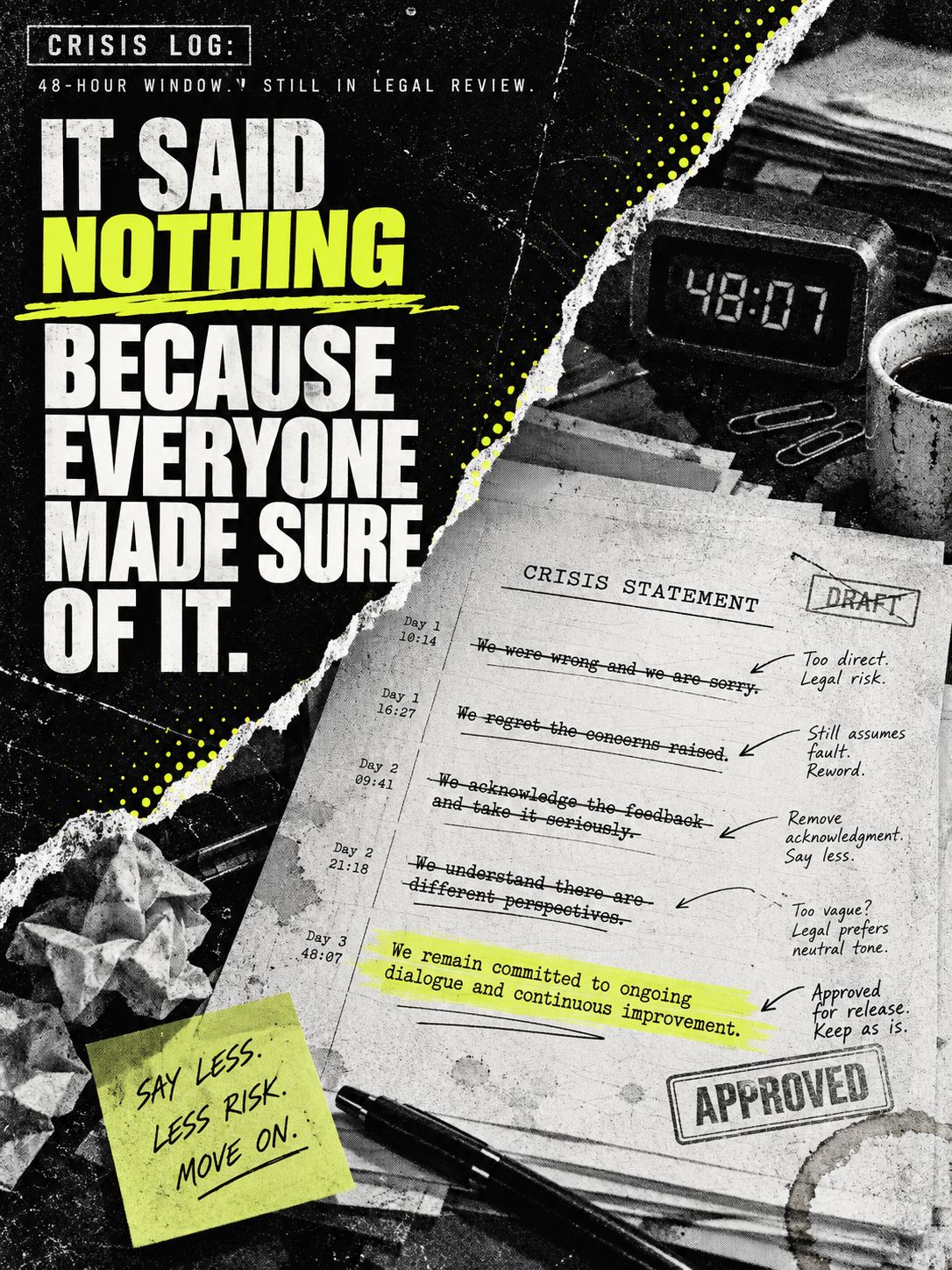
A company facing public criticism recently issued a statement so carefully hedged it managed to avoid saying anything at all. It remains unclear whether this was intentional caution or simply the product of too many people editing one paragraph, though the effect was the same either way. The story kept running. The silence filled in with someone else's narrative.
Reputation management as a discipline has a reasonably well-documented answer for what should have happened instead, and it has very little to do with clever phrasing.
What Reputation Management Actually Requires After a Crisis
Interestingly, the industry's own data is unusually consistent on this point. Brands that respond to negative press within the first 48 hours are 2.5 times more likely to recover public trust than those that delay, according to reputation management research from NewMedia, and ignoring a public crisis can produce a 25 percent drop in brand value within weeks. Speed, more than any single line in a statement, appears to be doing most of the actual work.
Sources might interpret this as evidence that most crisis response plans exist on paper and nowhere else, given how often the 48-hour window quietly passes before legal has finished reviewing a first draft.
Admitting the Mess Is Not Optional, Whatever the Legal Team Prefers
The campaign of deflection rarely survives contact with an audience that already suspects the truth. When Starbucks faced a widely publicized racial bias incident, the company closed stores nationwide for employee training rather than issuing a carefully worded non-apology. The message was less about the specific policy change and more about the willingness to disrupt normal operations to prove the point.
70 percent of consumers say they're more likely to support a company that admits mistakes quickly and takes corrective action, according to the same NewMedia reputation data. Deflection, by contrast, tends to read exactly as it is.
If the instinct is still to soften a statement until it says nothing, this breakdown of protecting your reputation online covers why proactive, specific communication beats a vague non-statement every time.
How Long Reputation Recovery Actually Takes
It remains unclear whether most executives have priced in the actual timeline. 73 percent of brands that invested in crisis management capabilities before an incident recovered faster than those that hadn't, according to crisis statistics compiled by Nadernejad Media, and the average mid-sized business crisis now carries an estimated cost near $3.3 million once legal exposure, lost revenue, and the slower cost of rebuilding trust are all accounted for.
The uncomfortable finding underneath that number is timing. Preparation completed before a crisis consistently outperforms preparation assembled during one, which is a distinction most companies discover the hard way, at the worst possible moment to be learning it.
What a Real Crisis Communication Plan Looks Like
A functioning crisis communication plan extends well past the first public statement. It typically identifies the root cause rather than the symptom, distinguishes between a one-time lapse and a systemic issue, and outlines immediate, mid-term, and long-term actions rather than a single apology meant to close the subject permanently.
70 percent of consumers trust companies more when they communicate openly during a crisis, according to reputation recovery research from PRSA, which suggests that continued, honest updates carry more weight than a single polished announcement ever will. Sharing progress publicly, even incrementally, tends to outperform a strategy of going quiet until the story is fully resolved.
For a broader read on whether coverage and outreach efforts are producing anything measurable, this breakdown of surviving negative PR with a clear head covers the same territory from a more tactical angle.
Why Brand Trust Doesn't Return on Its Own
Brand trust, once damaged, does not repair itself through the passage of time alone. It requires visible, sustained action, engaging directly with the audience that was affected, tracking sentiment rather than assuming it, and building the internal systems, reputation audits, crisis training, a rapid-response process, that prevent the next incident from starting the cycle over again.
The companies treating a crisis as a single, contained event tend to be the ones still explaining the same story months later. The companies treating it as the start of an ongoing practice tend to be the ones who aren't.
The Bottom Line on Reputation Management
None of this requires a dramatic reinvention of how a company communicates. Reputation management that works tends to be fast, specific, and honest about what went wrong, followed by consistent, visible progress rather than a single carefully worded statement meant to end the conversation. The brands still struggling with this are, in most cases
Don't Be A Little Pitch exists because most brands can recognize a poorly handled crisis instantly when it happens to someone else, and considerably less quickly when it's their own.
FAQ
How long does it take to recover from a PR crisis?
Recovery timelines vary widely, but brands that respond within 48 hours and follow through with sustained, transparent action tend to recover meaningfully faster than those that delay or offer only a single statement.
What should a company do first when a PR crisis hits?
The most effective first step is a fast, honest acknowledgment of the issue, followed by an investigation into the root cause, rather than a delayed or heavily hedged statement.
What is a crisis communication plan?
A crisis communication plan is a structured approach covering immediate response, mid-term trust-rebuilding actions, and long-term prevention measures, rather than a single reactive statement.
How can a brand rebuild trust after a scandal?
Rebuilding trust typically requires visible corrective action, ongoing transparent updates, and genuine engagement with affected stakeholders, sustained over time rather than delivered in one announcement.
Does responding quickly to a crisis actually make a difference?
Yes. Data consistently shows that faster response times correlate with significantly better trust recovery outcomes compared to delayed or defensive responses.

60-Day Performance Guarantee
PR only works if it builds momentum fast. If we do not secure 2 meaningful earned media features and line up 3 additional opportunities within 60 days, you get a full refund.

Free Authority Score Checker
Check your online reputation and authority score for free and see how you stack up and get custom tips to improve instantly.




.png)